
Monday, June 07, 2004
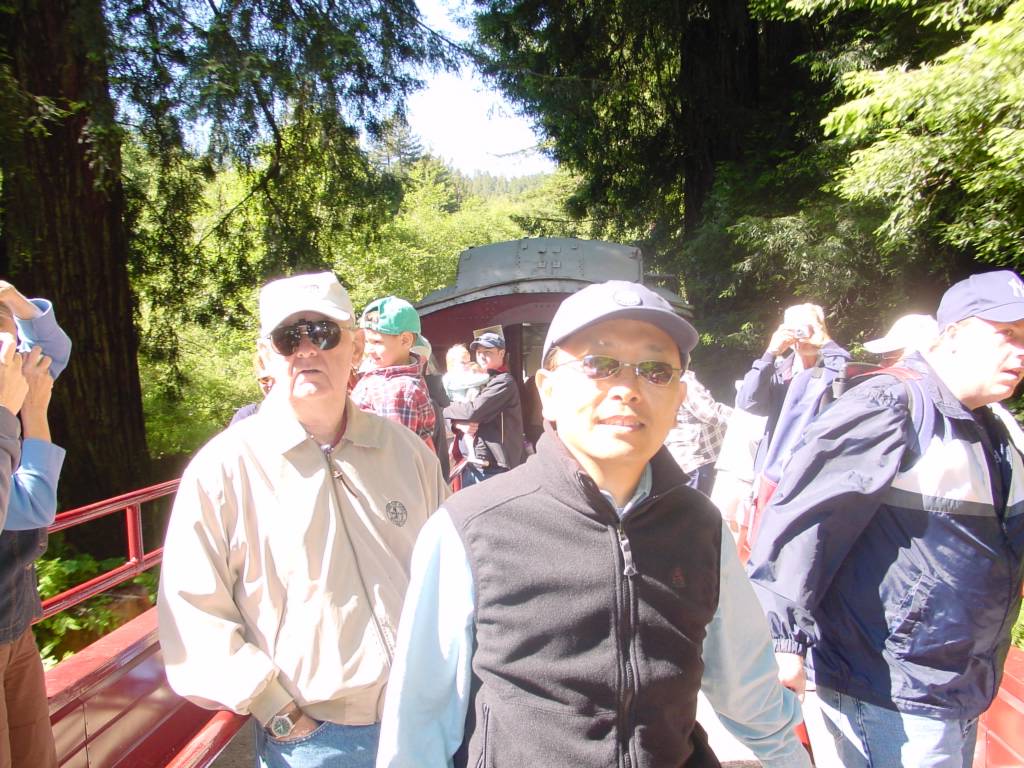
Me, Kimberly, my Globalfreeloaders.com host in Las Vegas, and Dan, the Canadian chemical engineer cum poker player who was also staying there. Dan was on his last stop of a 6 month+ trip around the world. We played Blackjack (and won) at the most down-and-out casino in Las Vegas: it had penny slot machines!



(A small digression.)
June 6, which ended few hours ago, is the 60th Anniversary of the Allied landings in Normandy. It’s also the 40th anniversary of my mother and I arriving in New York on an overnight flight from Rio de Janeiro, Brazil. I was twelve and half years old. My hand-luggage was my violin and a package of decorative display plates made of colorful butterfly wings arranged in geometric patterns, on which my mother had spent our last hyper-inflated Brazilian currency.
I had a buzz (!) haircut, knew a few phrases in English, and hadn’t seen my father in two years. He picked us up at Kennedy Airport – it may still have been called Idlewild – and we drove to Highland Park, NJ, about an hour away, in his blue 1963 Rambler American (which would later be known as “The Blue Box” by my friends when we got drivers’ licenses). I had never been on a four-lane highway, eaten potato chips, or had soft ice-cream. My total life-time hours of TV watching was less than ten hours, all of them in the week before departure, when we stayed with friends in the state capital, where there was TV reception. I would get to see the 1964 New York World’s Fair that my friends and I had read so much about. I would never see most of those friends again.
I thought about the above (and more) on the six hours of road today between Portland, OR and Lewiston, ID.
I will be spending Monday (June 7) on a 200 mile jet-boat trip up The Snake River that go to Deep Creek and Robinson’s Gulch, the sites, in 1887, of the worse massacre of Chinese in American history. (I mentioned, in one of the early entries, that this was going to be a highlight of my trip and why.) Those thirty-some miners came to America, leaving their families behind, much in the same way as my father had done, and for the same reason: to make a better life for their loved ones at enormous personal sacrifice. The difference is that he had the probability that his family would eventually be able to join him, whereas those miners did not. Instead, they died a violent and horrific death far from home and without their families ever knowing what befell them. They also received no justice from the system then and to this date, given the neglect and subsequent cover-up of the history of this heinous act. There is not even a historical marker at the site.
I was going to write that it’s debatable whether my parents’ ostensible reason for immigrating to the United States -- to give me, their only one child, a better future – was successful or not. Compared to the fate of those miners, it was. And it’s worth celebrating one and memorializing the other.
June 6, which ended few hours ago, is the 60th Anniversary of the Allied landings in Normandy. It’s also the 40th anniversary of my mother and I arriving in New York on an overnight flight from Rio de Janeiro, Brazil. I was twelve and half years old. My hand-luggage was my violin and a package of decorative display plates made of colorful butterfly wings arranged in geometric patterns, on which my mother had spent our last hyper-inflated Brazilian currency.
I had a buzz (!) haircut, knew a few phrases in English, and hadn’t seen my father in two years. He picked us up at Kennedy Airport – it may still have been called Idlewild – and we drove to Highland Park, NJ, about an hour away, in his blue 1963 Rambler American (which would later be known as “The Blue Box” by my friends when we got drivers’ licenses). I had never been on a four-lane highway, eaten potato chips, or had soft ice-cream. My total life-time hours of TV watching was less than ten hours, all of them in the week before departure, when we stayed with friends in the state capital, where there was TV reception. I would get to see the 1964 New York World’s Fair that my friends and I had read so much about. I would never see most of those friends again.
I thought about the above (and more) on the six hours of road today between Portland, OR and Lewiston, ID.
I will be spending Monday (June 7) on a 200 mile jet-boat trip up The Snake River that go to Deep Creek and Robinson’s Gulch, the sites, in 1887, of the worse massacre of Chinese in American history. (I mentioned, in one of the early entries, that this was going to be a highlight of my trip and why.) Those thirty-some miners came to America, leaving their families behind, much in the same way as my father had done, and for the same reason: to make a better life for their loved ones at enormous personal sacrifice. The difference is that he had the probability that his family would eventually be able to join him, whereas those miners did not. Instead, they died a violent and horrific death far from home and without their families ever knowing what befell them. They also received no justice from the system then and to this date, given the neglect and subsequent cover-up of the history of this heinous act. There is not even a historical marker at the site.
I was going to write that it’s debatable whether my parents’ ostensible reason for immigrating to the United States -- to give me, their only one child, a better future – was successful or not. Compared to the fate of those miners, it was. And it’s worth celebrating one and memorializing the other.
Saturday, June 05, 2004
Catch up post-Carmel
(Sometime during yesterday’s drive from Ferndale on the northern California coast to Ashland, OR, my direction turned eastward for the first time since starting out twenty-three days ago. It’s still a long way from Philadelphia, but I’m homeward bound, even though Eugene and Portland are still ahead and northward.)
On Thursday night, I saw a production of “The Comedy of Errors” at the Oregon Shakespeare Festival in Ashland, where my seat was the boundary between a group of thirty-eight seventh-graders from Richmond, CA and twenty-seven eighth-graders from Santa Cruz. Contrary to how you might expect this to continue -- given that opening sentence – they were very well-behaved, once seated and during the show. However, it was a different story in the ubiquitous gift-shop beforehand. There, they ran somewhere between “amok” and “unsupervised”. The few chaperones I could see confined themselves to saying: “This isn’t the only store we’ll be going to” and “You don’t have to spend all your money in one place”. The volunteer sales staff, mostly older ladies of genteel breeding (as they used to say), gave murderous looks but shed no blood. I paid for my purchase and hurried out, wondering what it would be like inside. (While selecting a T-shirt, I chatted with a goateed man who had seen Kenneth Branagh (sic) do Henry IV at Stratford-upon-Avon in 1984 AND caught caught an apple-core thrown to the pit audience during an “As You Like It” production at “The Globe” in London. He kept it as a memento. (My ticket-stub to “Taming of the Shrew” there last August hasn’t shrivelled or browned…)
The last few days, since the wedding in Monterey on Sunday, most of the drive has been on the northern stretch of the Highway 1, from Point Reyes near San Francisco to Crescent City, close to the border with Oregon, some 200+ miles. The scenery is even more spectacular than the section in southern California, as it includes old-growth redwood forests. (A video I watched at the Redwoods National Park information center showed that only 5% remains of the redwood groves that covered California before logging from the Gold Rush (1849) onwards.)
In particular, the 32 mile drive called “Avenue of the Giants” is not to be missed. It’s a two-lane road flanked by trees averaging over 200 ft. in height, some with trunks wider than the longest SUVs. (The bark alone, in the older ones that are as much as 2000 years old, is up to 18 inches thick.) Photos don’t do them justice without placing a person for scale. For long stretches, mine was the only car in sight, and riding with the top down I could feel the full effect of their majesty. The sunlight had to zig-zag such a long way through the leaves to reach ground-level that it would hard to tell the time of day by the speckled shadows. And when I stopped beside a toppled tree, whose cross-section was taller than the top of a basketball backboard, and shut the engine, the stillness, until a car went by a minute or so later, was eerie. I felt very, very small and like an intruder.
Looking at the rings of that redwood tree brought thoughts about Carlsbad Caverns, and time-scales in the animal, vegetable, and mineral kingdoms. A thousand years in the formation of a staglamatite barely makes it noticeable, no more than a wet bump. For a redwood, the same amount of time produces a specimen that is the equivalent of an “emerging adult” in human terms. For us, “a thousand years” has no meaning for an individual life. It’s no wonder that I felt both very mortal yet also awed by how a creature of such limited lifespan, which is not even the longest in the animal kingdom, can disrupt and destroy the lives of all species AND the physical world. Makes me proud to be a homo sapiens….
I also noticed a different set of reactions driving through this northern hilly and forested landscape versus the open and sparsely vegetated Southwest. Both environments have many places where the scenery stretches for miles in almost every direction, and where the viewer feels the way the Devil intended Jesus to feel when he tempted Him in the desert: like a king surveying his domain. Yet, while the vistas of green hills dropping down to rivers winding through cultivated valleys did, indeed, give that feeling of awed “ownership”, the Southwest sights of canyons, mesas, red hills, and junipers and sagebrush evoked a sense of awe and futility.
Reflecting that difference, I realized that it had to do with man’s control over Nature. How I felt depended on how much I felt the environment could be controlled: forests are easier to raze than deserts are to make bloom. It was that simple. It may be that obvious to others, but it wasn’t to me, until that moment, how that kind of a Man-centered view, is not necessarily a good way to look at the world.
A road-story. On the way to Mendocino on Tuesday, I stopped to eat a sandwich at the roadside tables of a gift shop in a little widening of Highway 1 called Jenner, CA, 95450, and offered to take a photo of a young couple with a baby. We exchanged no more than a dozen words and they left me to eat my sandwich in the company of a pelican. (“Fred” – he looked like a “Fred” – liked the wheat bread, the red onion, and the turkey breast I shared with him. He also became bolder as lunch progressed.) A few hours later, as I was unloading my luggage at McElvoy’s Inn in Mendocino, the same couple emerged from the room next to mine. We exchanged another dozen words about “what a small world” and went our separate ways, though not before I did do my parlor-trick of guessing baby ages – I guessed 16 months and he was 14 months. (For those who know child development, that’s NOT too bad a guess.)
The next morning, as I was loading the car for the drive to Ferndale, I saw the young woman and the baby. In the dozen words that included asking where they were headed, she said: “To Fort Bragg to take the ‘Skunk Train’.” “What’s that?”, I asked. “Oh, it’s a steam-engine excursion train that goes into the redwoods.”, she replied. “How long is the trip?”, I asked. “It leaves at 9:30am and returns to Fort Bragg at 1 pm.”, she said. (It was now 8:50 am and Fort Bragg was about 15 minutes away.) “I never heard of it. Sound pretty neat. Thanks! Maybe I’ll see you there.”, I answered. “OK, see you!”, and she left. I did a quick review of my plans for the day (none) and calculated whether I had the time to still get to Ferndale before dark (yes). I made the train with five minutes to spare, including parking and purchasing a ticket.
The couple, whose names I never got, were taking a month to travel, having quit their jobs in Indiana to move back to the Twin Cities area of Minnesota. He was a Lutheran minister doing youth ministry and was planning to get a PhD in that area. During the ride – which was relaxing albeit not very exciting in terms of route or scenery -- we had a great conversation about “callings”, taking chances, traveling with toddlers, fundamentalism, and continuing education. They were very warm and engaging and radiated both wholesomeness and a clear delight with each other. I wouldn’t have met them or experienced “The Skunk Train” and learned a piece of local/California history, if I hadn’t offered to take their photo in Jenner. Now, they had a personal photographer…
(Sometime during yesterday’s drive from Ferndale on the northern California coast to Ashland, OR, my direction turned eastward for the first time since starting out twenty-three days ago. It’s still a long way from Philadelphia, but I’m homeward bound, even though Eugene and Portland are still ahead and northward.)
On Thursday night, I saw a production of “The Comedy of Errors” at the Oregon Shakespeare Festival in Ashland, where my seat was the boundary between a group of thirty-eight seventh-graders from Richmond, CA and twenty-seven eighth-graders from Santa Cruz. Contrary to how you might expect this to continue -- given that opening sentence – they were very well-behaved, once seated and during the show. However, it was a different story in the ubiquitous gift-shop beforehand. There, they ran somewhere between “amok” and “unsupervised”. The few chaperones I could see confined themselves to saying: “This isn’t the only store we’ll be going to” and “You don’t have to spend all your money in one place”. The volunteer sales staff, mostly older ladies of genteel breeding (as they used to say), gave murderous looks but shed no blood. I paid for my purchase and hurried out, wondering what it would be like inside. (While selecting a T-shirt, I chatted with a goateed man who had seen Kenneth Branagh (sic) do Henry IV at Stratford-upon-Avon in 1984 AND caught caught an apple-core thrown to the pit audience during an “As You Like It” production at “The Globe” in London. He kept it as a memento. (My ticket-stub to “Taming of the Shrew” there last August hasn’t shrivelled or browned…)
The last few days, since the wedding in Monterey on Sunday, most of the drive has been on the northern stretch of the Highway 1, from Point Reyes near San Francisco to Crescent City, close to the border with Oregon, some 200+ miles. The scenery is even more spectacular than the section in southern California, as it includes old-growth redwood forests. (A video I watched at the Redwoods National Park information center showed that only 5% remains of the redwood groves that covered California before logging from the Gold Rush (1849) onwards.)
In particular, the 32 mile drive called “Avenue of the Giants” is not to be missed. It’s a two-lane road flanked by trees averaging over 200 ft. in height, some with trunks wider than the longest SUVs. (The bark alone, in the older ones that are as much as 2000 years old, is up to 18 inches thick.) Photos don’t do them justice without placing a person for scale. For long stretches, mine was the only car in sight, and riding with the top down I could feel the full effect of their majesty. The sunlight had to zig-zag such a long way through the leaves to reach ground-level that it would hard to tell the time of day by the speckled shadows. And when I stopped beside a toppled tree, whose cross-section was taller than the top of a basketball backboard, and shut the engine, the stillness, until a car went by a minute or so later, was eerie. I felt very, very small and like an intruder.
Looking at the rings of that redwood tree brought thoughts about Carlsbad Caverns, and time-scales in the animal, vegetable, and mineral kingdoms. A thousand years in the formation of a staglamatite barely makes it noticeable, no more than a wet bump. For a redwood, the same amount of time produces a specimen that is the equivalent of an “emerging adult” in human terms. For us, “a thousand years” has no meaning for an individual life. It’s no wonder that I felt both very mortal yet also awed by how a creature of such limited lifespan, which is not even the longest in the animal kingdom, can disrupt and destroy the lives of all species AND the physical world. Makes me proud to be a homo sapiens….
I also noticed a different set of reactions driving through this northern hilly and forested landscape versus the open and sparsely vegetated Southwest. Both environments have many places where the scenery stretches for miles in almost every direction, and where the viewer feels the way the Devil intended Jesus to feel when he tempted Him in the desert: like a king surveying his domain. Yet, while the vistas of green hills dropping down to rivers winding through cultivated valleys did, indeed, give that feeling of awed “ownership”, the Southwest sights of canyons, mesas, red hills, and junipers and sagebrush evoked a sense of awe and futility.
Reflecting that difference, I realized that it had to do with man’s control over Nature. How I felt depended on how much I felt the environment could be controlled: forests are easier to raze than deserts are to make bloom. It was that simple. It may be that obvious to others, but it wasn’t to me, until that moment, how that kind of a Man-centered view, is not necessarily a good way to look at the world.
A road-story. On the way to Mendocino on Tuesday, I stopped to eat a sandwich at the roadside tables of a gift shop in a little widening of Highway 1 called Jenner, CA, 95450, and offered to take a photo of a young couple with a baby. We exchanged no more than a dozen words and they left me to eat my sandwich in the company of a pelican. (“Fred” – he looked like a “Fred” – liked the wheat bread, the red onion, and the turkey breast I shared with him. He also became bolder as lunch progressed.) A few hours later, as I was unloading my luggage at McElvoy’s Inn in Mendocino, the same couple emerged from the room next to mine. We exchanged another dozen words about “what a small world” and went our separate ways, though not before I did do my parlor-trick of guessing baby ages – I guessed 16 months and he was 14 months. (For those who know child development, that’s NOT too bad a guess.)
The next morning, as I was loading the car for the drive to Ferndale, I saw the young woman and the baby. In the dozen words that included asking where they were headed, she said: “To Fort Bragg to take the ‘Skunk Train’.” “What’s that?”, I asked. “Oh, it’s a steam-engine excursion train that goes into the redwoods.”, she replied. “How long is the trip?”, I asked. “It leaves at 9:30am and returns to Fort Bragg at 1 pm.”, she said. (It was now 8:50 am and Fort Bragg was about 15 minutes away.) “I never heard of it. Sound pretty neat. Thanks! Maybe I’ll see you there.”, I answered. “OK, see you!”, and she left. I did a quick review of my plans for the day (none) and calculated whether I had the time to still get to Ferndale before dark (yes). I made the train with five minutes to spare, including parking and purchasing a ticket.
The couple, whose names I never got, were taking a month to travel, having quit their jobs in Indiana to move back to the Twin Cities area of Minnesota. He was a Lutheran minister doing youth ministry and was planning to get a PhD in that area. During the ride – which was relaxing albeit not very exciting in terms of route or scenery -- we had a great conversation about “callings”, taking chances, traveling with toddlers, fundamentalism, and continuing education. They were very warm and engaging and radiated both wholesomeness and a clear delight with each other. I wouldn’t have met them or experienced “The Skunk Train” and learned a piece of local/California history, if I hadn’t offered to take their photo in Jenner. Now, they had a personal photographer…
Friday, June 04, 2004
Sunday, May 30, 2004
Day 19 - Photos: Janet and Gary's wedding in Monterey.
Yesterday (Sat.) was my friend Janet's wedding, the reason for being in Carmel on these days. The ceremony was outdoors, under perfect skies, at the Memory Gardens behind the original Customs House, now a visitor center, in Monterey.
I had been asked by Janet to write some advice, a task with which I struggled, but was saved by finding I poem that was brief, beautiful, and by a Chinese woman poet from the late 1200s, to which I added some words (not to the poem!). Now, I know most of you reading this are chuckling at the thought of me being qualified to give marital hints, but I would argue that, sometimes, those on the outside can see better than those inside. Sometimes. (I certainly know more now than when I got married. After all, Aeschylus wrote: "The reward of suffering is experience.")
In any case, here are some photos of the occasion.
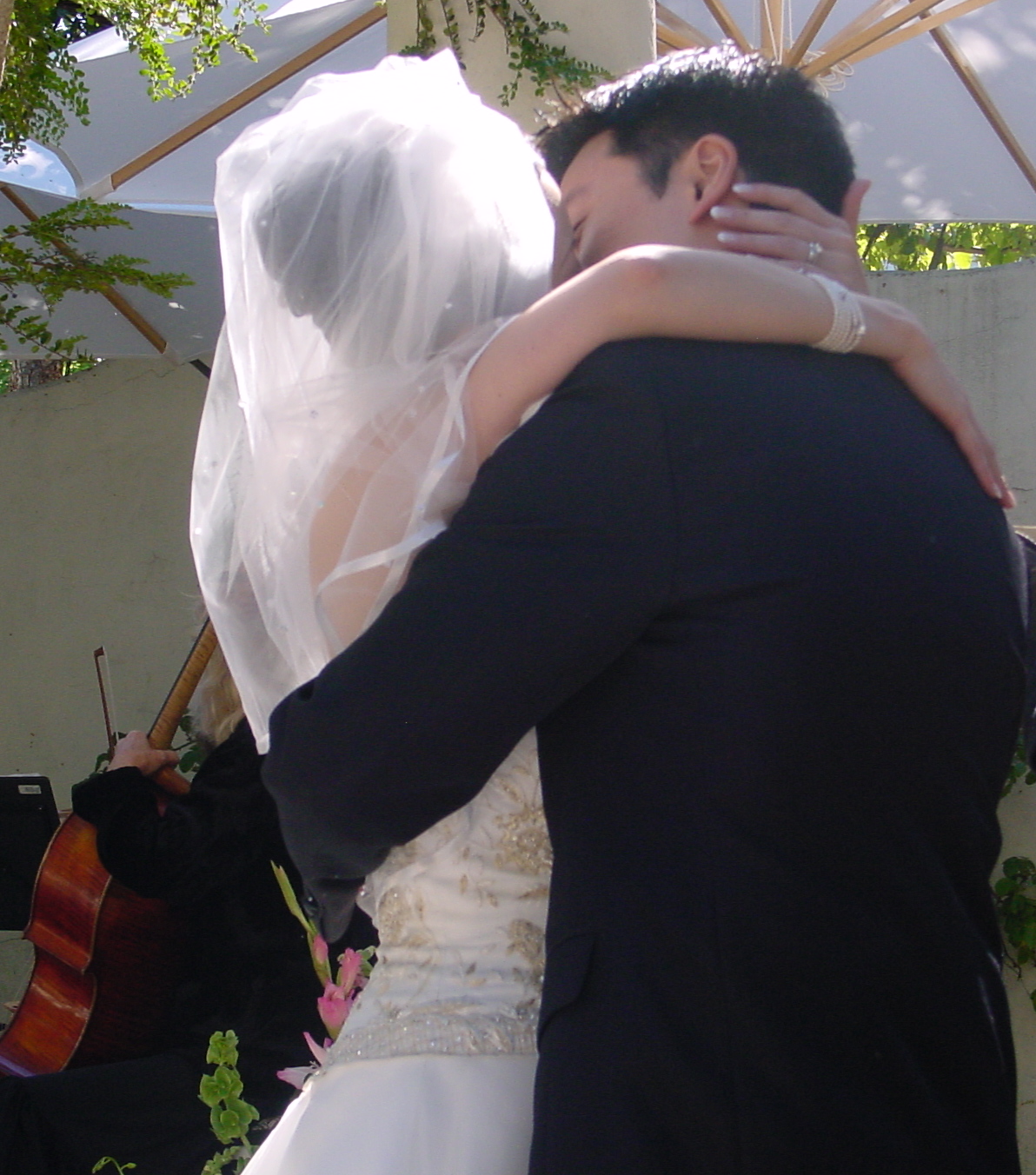
The first married kiss:
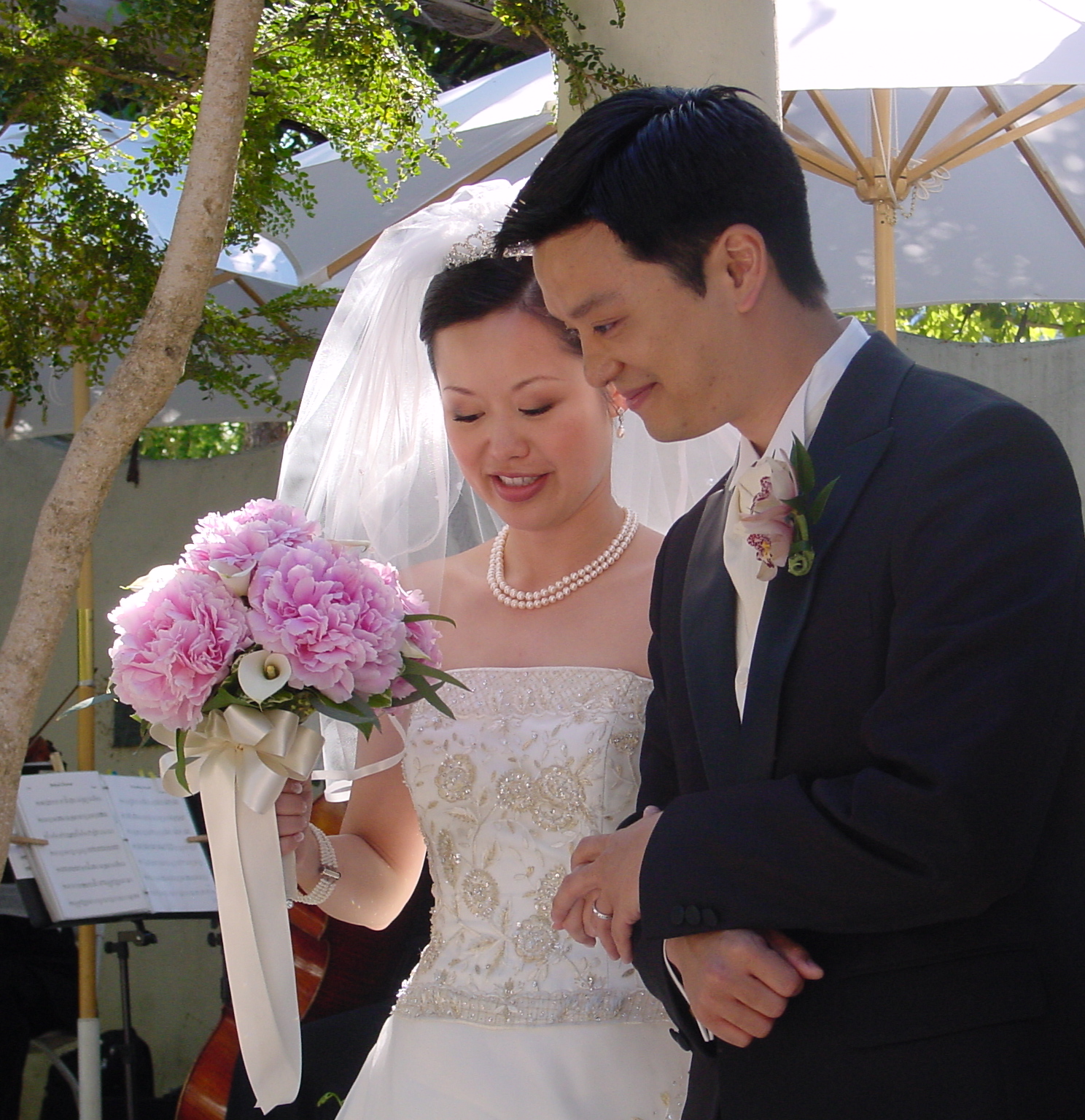
Ringed and married:
Yesterday (Sat.) was my friend Janet's wedding, the reason for being in Carmel on these days. The ceremony was outdoors, under perfect skies, at the Memory Gardens behind the original Customs House, now a visitor center, in Monterey.
I had been asked by Janet to write some advice, a task with which I struggled, but was saved by finding I poem that was brief, beautiful, and by a Chinese woman poet from the late 1200s, to which I added some words (not to the poem!). Now, I know most of you reading this are chuckling at the thought of me being qualified to give marital hints, but I would argue that, sometimes, those on the outside can see better than those inside. Sometimes. (I certainly know more now than when I got married. After all, Aeschylus wrote: "The reward of suffering is experience.")
In any case, here are some photos of the occasion.
The first married kiss:
Ringed and married:
Day 18 – Saturday (Carmel)– Catching up: concluding “Henry”.
I only arrived in Carmel two days ago, yet it feels much longer. The room at The Carriage House Inn is spacious and comfortable, the management very friendly, and the location can’t be beat: secluded yet just a block from the main intersection in the “downtown” area. Carmel is only one square mile, so it’s amusing to think of it as having a downtown. However, those few square blocks that qualify are a warren of little courtyards and alleys crammed with a mixture of boutiques for visitors and services for locals. It’s a good place to avoid if both your credit card limit and tolerance for “tchotkes” is low. These four nights in Carmel – tonight is the third one -- are roughly at the half-way mark but feel more like a destination. I am simultaneously rested and tired: I miss the familiar in Philadelphia yet feel detached from it.
Unlike past transcontinental trips where the transition from East Coast to West Coast was almost magical, covered in six hours on an airplane, this one has taken eleven days. Instead of being “driven” in a DC-10 or 737, I’ve been at the wheel of the 4,156 miles between home and Los Angeles. Both these differences made for a gradual transition, of an acceptance of successive alien environments as being the norm, until being in the unfamiliar felt natural. (Hmm…sounds like the proverbial way to keep a frog from jumping out of the cooking pot:: start with cold water, turn up the heat slowly, and it will be boiled before it realizes it…) My sense of distance – and distancing – from Philadelphia is unlike any felt before, even when physically farther, like during trips to China. Knowledge that my old workplace, part of the familiar, will not be there upon return also makes “home” feel less like “home” and adds to the theme of the trip being a search.
It’s all connected to the conversation with Henry, the young Navajo man met in Arizona. As we talked on that climb back to the mesa top in Canyon de Chelly (see earlier posting), the subject had turned from work to life-direction, his and mine. He had recognized that the “runnin’ ‘round” on his woman and doing “crazy stuff” when he was younger – this is someone who fathered his first child at sixteen – was an empty life (his words also). In his emptiness and struggle for direction and meaning – not surprising given the opportunities in the Reservation – he had turned toward traditional Navajo religion and not found comfort. Then he tried Christianity and had found God, in the form of a Pentecostal congregation. Now his faith gave him a center, which helped him be a partner to his girlfriend and mother of the four children.
He said all this, at once matter-of-factly and with dignity, in a soft-spoken voice as we made our way, sometimes side-by-side, sometimes single-file, depending on the width of the trail. Speech, on both our parts, was a little halting from the exertion, which increased as we progressed up the canyon-side. (The sun was closer to noon-height and strength by this time, and I was glad to be wearing the silly-looking desert-cap with the “skirt” for the back of neck, though I looked nothing like Gary Cooper in “Beau Geste”.) Now and then, he would turn to talk to his son, who had yet to peak a word. (I had offered him one of my water bottles, since they weren’t carrying any, and he refused it twice, only accepting after a glance to and permission from Henry.) When I commented on the silence, wondering how much it had to do with the problems -- drinking and “mental”-- that Henry had mentioned, he said that the son was quiet around strangers, but would probably ask a lot of questions once they were alone. He was an alert little boy, with inquisitive eyes that showed more going on than verbalized. (He remained silent, even when we had reached the cars and I handed him my digital camera to take a photo of Henry and me, but listened attentively to my instructions and followed them perfectly. When Henry instructed him to say good-bye properly, the handshake was firm and he locked eyes with no hint of shyness.)
Earlier in the hike, when we were still exchanging basic information, i.e. the “where” and “what” of each other, I had shared with Henry that I had left my firm and that one purpose of my trip was to ponder the next stage. Now, after telling how new-found faith had turned his life around, he said to me, in his lightly accented and slightly rhythmic voice: “You look like – I know you are – a smart man; I know you can do a lot good with what you know. Maybe I was put on your path for something; maybe to tell you that.” And then, turning fully around, as we stopped in the shade some rocks (I needed it): “Maybe it will fill the emptiness inside, you know?”, at the same time touching his chest/heart with his right hand. I didn’t know how to respond and it took me a couple of seconds to say: “Maybe you’re right.”
Near the beginning of this trip, I had made a less-than-serious comparison, in an email to a friend, to perhaps being a later-day Paul on the road to Damascus and maybe finding faith. I have hoped, all my life, to receive a “sign” because, deep inside, I want divine guidance (for one thing, it alleviates personal responsibility and the burden of choice). However, being a skeptic and a cynic (albeit an oxymoronic one, i.e. a cynical Romantic), potential “signs” have always been terribly Delphic, i.e. ambiguous and subject to any desired interpretation.
What Henry gave words to, I had already been thinking for several dozen steps. Was it more than coincidental, those words from a Native American when I was already thinking about ways for applying my experience and skill sets on behalf of that group? Could a “sign” be any more explicit? These are the questions that have been uppermost in my mind during the empty stretches of road since that day. (The roads haven’t been empty since reaching – and leaving – LA, so the questions have been less in the foreground. I suspect they will become stronger again in the stretch homeward after next week.)
We exchanged contact information in the parking lot – I will be sending his son copies of the photos – and then we said good bye after a hug (with Henry) and the aforementioned handshake with his son. I know that we will be in touch.
I only arrived in Carmel two days ago, yet it feels much longer. The room at The Carriage House Inn is spacious and comfortable, the management very friendly, and the location can’t be beat: secluded yet just a block from the main intersection in the “downtown” area. Carmel is only one square mile, so it’s amusing to think of it as having a downtown. However, those few square blocks that qualify are a warren of little courtyards and alleys crammed with a mixture of boutiques for visitors and services for locals. It’s a good place to avoid if both your credit card limit and tolerance for “tchotkes” is low. These four nights in Carmel – tonight is the third one -- are roughly at the half-way mark but feel more like a destination. I am simultaneously rested and tired: I miss the familiar in Philadelphia yet feel detached from it.
Unlike past transcontinental trips where the transition from East Coast to West Coast was almost magical, covered in six hours on an airplane, this one has taken eleven days. Instead of being “driven” in a DC-10 or 737, I’ve been at the wheel of the 4,156 miles between home and Los Angeles. Both these differences made for a gradual transition, of an acceptance of successive alien environments as being the norm, until being in the unfamiliar felt natural. (Hmm…sounds like the proverbial way to keep a frog from jumping out of the cooking pot:: start with cold water, turn up the heat slowly, and it will be boiled before it realizes it…) My sense of distance – and distancing – from Philadelphia is unlike any felt before, even when physically farther, like during trips to China. Knowledge that my old workplace, part of the familiar, will not be there upon return also makes “home” feel less like “home” and adds to the theme of the trip being a search.
It’s all connected to the conversation with Henry, the young Navajo man met in Arizona. As we talked on that climb back to the mesa top in Canyon de Chelly (see earlier posting), the subject had turned from work to life-direction, his and mine. He had recognized that the “runnin’ ‘round” on his woman and doing “crazy stuff” when he was younger – this is someone who fathered his first child at sixteen – was an empty life (his words also). In his emptiness and struggle for direction and meaning – not surprising given the opportunities in the Reservation – he had turned toward traditional Navajo religion and not found comfort. Then he tried Christianity and had found God, in the form of a Pentecostal congregation. Now his faith gave him a center, which helped him be a partner to his girlfriend and mother of the four children.
He said all this, at once matter-of-factly and with dignity, in a soft-spoken voice as we made our way, sometimes side-by-side, sometimes single-file, depending on the width of the trail. Speech, on both our parts, was a little halting from the exertion, which increased as we progressed up the canyon-side. (The sun was closer to noon-height and strength by this time, and I was glad to be wearing the silly-looking desert-cap with the “skirt” for the back of neck, though I looked nothing like Gary Cooper in “Beau Geste”.) Now and then, he would turn to talk to his son, who had yet to peak a word. (I had offered him one of my water bottles, since they weren’t carrying any, and he refused it twice, only accepting after a glance to and permission from Henry.) When I commented on the silence, wondering how much it had to do with the problems -- drinking and “mental”-- that Henry had mentioned, he said that the son was quiet around strangers, but would probably ask a lot of questions once they were alone. He was an alert little boy, with inquisitive eyes that showed more going on than verbalized. (He remained silent, even when we had reached the cars and I handed him my digital camera to take a photo of Henry and me, but listened attentively to my instructions and followed them perfectly. When Henry instructed him to say good-bye properly, the handshake was firm and he locked eyes with no hint of shyness.)
Earlier in the hike, when we were still exchanging basic information, i.e. the “where” and “what” of each other, I had shared with Henry that I had left my firm and that one purpose of my trip was to ponder the next stage. Now, after telling how new-found faith had turned his life around, he said to me, in his lightly accented and slightly rhythmic voice: “You look like – I know you are – a smart man; I know you can do a lot good with what you know. Maybe I was put on your path for something; maybe to tell you that.” And then, turning fully around, as we stopped in the shade some rocks (I needed it): “Maybe it will fill the emptiness inside, you know?”, at the same time touching his chest/heart with his right hand. I didn’t know how to respond and it took me a couple of seconds to say: “Maybe you’re right.”
Near the beginning of this trip, I had made a less-than-serious comparison, in an email to a friend, to perhaps being a later-day Paul on the road to Damascus and maybe finding faith. I have hoped, all my life, to receive a “sign” because, deep inside, I want divine guidance (for one thing, it alleviates personal responsibility and the burden of choice). However, being a skeptic and a cynic (albeit an oxymoronic one, i.e. a cynical Romantic), potential “signs” have always been terribly Delphic, i.e. ambiguous and subject to any desired interpretation.
What Henry gave words to, I had already been thinking for several dozen steps. Was it more than coincidental, those words from a Native American when I was already thinking about ways for applying my experience and skill sets on behalf of that group? Could a “sign” be any more explicit? These are the questions that have been uppermost in my mind during the empty stretches of road since that day. (The roads haven’t been empty since reaching – and leaving – LA, so the questions have been less in the foreground. I suspect they will become stronger again in the stretch homeward after next week.)
We exchanged contact information in the parking lot – I will be sending his son copies of the photos – and then we said good bye after a hug (with Henry) and the aforementioned handshake with his son. I know that we will be in touch.
Friday, May 28, 2004
Day 16 – Cambria to Carmel, CA (San Simeon and the road)
Thursday morning – it’s now past midnight Thursday night, so it’s actually Friday already – I was woken up by a 7 am phone call from a telemarketer on East Coast time. (I thought of Henry II’s cry that led to Beckett's death in Canterbury Cathedral: “Will no one rid me of this man?” as I wished murder on him.) Unable to fall asleep again, I uploaded a couple of more photos to earlier postings. (I know the photos require scrolling, vertical and horizontal, to see fully. I can’t find a “sized to fit screen” feature….sorry!)
The morning was still gray, cool, and cloudy when I checked out at 10:30 am. to tour Hearst Castle, which, being high on a hill overlooking San Simeon, was enshrouded in wispy fog that obscured the towers of the main building. I signed up for tour #1 encompassing the major public rooms of the “Casa Grande”, the two pools – one indoors, one outdoors – and one of the guest-houses on the grounds. Our group was large, filling one big bus, and shepherded by two guides, one acting as a rear-guard and security monitor (to prevent light fingers).
Hearst Castle, at 115 rooms, is the second largest private house in the country. (Biltmore, in Ashville, NC, the largest at 255 rooms, was my second stop of this trip. Given that the two houses are at almost opposite ends of the country, they aren't competing attractions, like having to choose between The Metropolitan or MOMA when in New York City.) Of the two, Hearst Castle is, far and away, the more interestingly furnished property: William Randolph Hearst was much more eclectic in his tastes and acquired boat-loads of antiques ranging from Dynastic Egypt sculptures from Luxor to 17th century Flemish tapestries. Vanderbilt, on the contrary, focused more on French Period-furniture (the ornate and gilded “Louis numeral” variety). Interestingly, while both were at their height of wealth when Impressionist art was cheap and available, neither seemed to have had a real eye (or prescience) for it. (Biltmore does have a few paintings by Cassatt and Sargent, if memory serves, but very few.) Contrast them with Dr. Barnes, who was not in the same league in wealth as either Hearst or Vanderbilt, yet amassed the collection of world-class Impressionist work that became the Barnes Foundation.
Sexism advisory: women and others likely to roll their eyes when cars are called "she" can skip forward because it's going to get worse before it returns to normal. Men will appreciate and understand. So, vive la diference!)
The drive from Hearst Castle to Carmel was Baby's opportunity to strut her stuff. While parts of the drive through Texas, New Mexico, and Arizona showed her speed, I had looked forward to the Pacific Coast Highway as the test of her other qualities, chiefly her handling and responsiveness to a challenging course.
The ninety-four miles to Carmel from San Simeon had the same elements and similar terrain as parts of the drive from LA to Cambria/San Simeon, but the difference was in the quantity (and quality) of the hair-pin turns and descents and ascents as it followed the rugged coastline. If the LA-Cambria stretch was a Hershey bar, the section to Carmel was the hand-made, 90% cocoa content, dark chocolate from Mary’s Chocolatier in Brussels. Both are “chocolate”, but where one is serviceable, the other is sublime, the sine qua non of the genre, with Baby the chocaholic. Her engine purred or growled, as appropriate and on demand, and she slalomed curves with the precision and speed of an Olympic skier. I had only to think a motion, a lean, a gear, and she had responded already. When she passed other cars – she was not passed once – it was with ease and assurance: more often, slower brethren, sensing her need to express, pulled to the side to let her through. It was an exhilarating hundred minutes and, contrary to how it might sound by my description, the safest I have ever felt driving under those conditions. In summary, I didn’t push her as a car: she pushed me as a driver. I can’t wait for the Northern California section to the redwoods! (Ok, I’m back to normal now, the exorcism worked. But, again, too late – it’s 2:30 am – to continue the Henry story. Tomorrow. Promise.)
Thursday morning – it’s now past midnight Thursday night, so it’s actually Friday already – I was woken up by a 7 am phone call from a telemarketer on East Coast time. (I thought of Henry II’s cry that led to Beckett's death in Canterbury Cathedral: “Will no one rid me of this man?” as I wished murder on him.) Unable to fall asleep again, I uploaded a couple of more photos to earlier postings. (I know the photos require scrolling, vertical and horizontal, to see fully. I can’t find a “sized to fit screen” feature….sorry!)
The morning was still gray, cool, and cloudy when I checked out at 10:30 am. to tour Hearst Castle, which, being high on a hill overlooking San Simeon, was enshrouded in wispy fog that obscured the towers of the main building. I signed up for tour #1 encompassing the major public rooms of the “Casa Grande”, the two pools – one indoors, one outdoors – and one of the guest-houses on the grounds. Our group was large, filling one big bus, and shepherded by two guides, one acting as a rear-guard and security monitor (to prevent light fingers).
Hearst Castle, at 115 rooms, is the second largest private house in the country. (Biltmore, in Ashville, NC, the largest at 255 rooms, was my second stop of this trip. Given that the two houses are at almost opposite ends of the country, they aren't competing attractions, like having to choose between The Metropolitan or MOMA when in New York City.) Of the two, Hearst Castle is, far and away, the more interestingly furnished property: William Randolph Hearst was much more eclectic in his tastes and acquired boat-loads of antiques ranging from Dynastic Egypt sculptures from Luxor to 17th century Flemish tapestries. Vanderbilt, on the contrary, focused more on French Period-furniture (the ornate and gilded “Louis numeral” variety). Interestingly, while both were at their height of wealth when Impressionist art was cheap and available, neither seemed to have had a real eye (or prescience) for it. (Biltmore does have a few paintings by Cassatt and Sargent, if memory serves, but very few.) Contrast them with Dr. Barnes, who was not in the same league in wealth as either Hearst or Vanderbilt, yet amassed the collection of world-class Impressionist work that became the Barnes Foundation.
Sexism advisory: women and others likely to roll their eyes when cars are called "she" can skip forward because it's going to get worse before it returns to normal. Men will appreciate and understand. So, vive la diference!)
The drive from Hearst Castle to Carmel was Baby's opportunity to strut her stuff. While parts of the drive through Texas, New Mexico, and Arizona showed her speed, I had looked forward to the Pacific Coast Highway as the test of her other qualities, chiefly her handling and responsiveness to a challenging course.
The ninety-four miles to Carmel from San Simeon had the same elements and similar terrain as parts of the drive from LA to Cambria/San Simeon, but the difference was in the quantity (and quality) of the hair-pin turns and descents and ascents as it followed the rugged coastline. If the LA-Cambria stretch was a Hershey bar, the section to Carmel was the hand-made, 90% cocoa content, dark chocolate from Mary’s Chocolatier in Brussels. Both are “chocolate”, but where one is serviceable, the other is sublime, the sine qua non of the genre, with Baby the chocaholic. Her engine purred or growled, as appropriate and on demand, and she slalomed curves with the precision and speed of an Olympic skier. I had only to think a motion, a lean, a gear, and she had responded already. When she passed other cars – she was not passed once – it was with ease and assurance: more often, slower brethren, sensing her need to express, pulled to the side to let her through. It was an exhilarating hundred minutes and, contrary to how it might sound by my description, the safest I have ever felt driving under those conditions. In summary, I didn’t push her as a car: she pushed me as a driver. I can’t wait for the Northern California section to the redwoods! (Ok, I’m back to normal now, the exorcism worked. But, again, too late – it’s 2:30 am – to continue the Henry story. Tomorrow. Promise.)
Thursday, May 27, 2004
Day 15- Wed.: LA to Cambria, CA (San Simeon) and filling in the gaps
I woke this morning in LA to the persistent barking of a dog, but will be going to sleep shortly to the sound of the Pacific Ocean, less than a hundred yards away from tonight’s lodgings in Cambria, about 250 miles north of LA on the Pacific Coast Highway. I am also just two miles south of San Simeon, site of the Hearst Castle, my destination in the morning.
Today (Wed) was the first day since leaving Philadelphia two weeks ago that the top went down on the car. It was too wet in the Southeast, and both too hot and too dusty through the Southwest. (Besides, having listened to that dermatologist on NPR speak about skin damage from too much sun AND having a parent who died from melanoma, I'm leery of prolonged exposure despite liberal application of sun-block.) The California weather and the road were a commercial for convertibles: mid-60s temperature with a light wind, blue skies, and a road that varied from coast-hugging with dramatic ocean views to undulating through rolling hills and irrigated fields. All that was missing was Grace Kelly in the passenger seat....though I'd have settled for her driving and me being Cary Grant. She could've shelled the garlic-roasted Pistachios for me: it's tough to do with one hand and drive. (What? You thought I wanted her there for her looks??)
I am looking forward to the next four nights because they will ALL be in one place, ie. no packing and unpacking every day! Several months ago, when I knew that I'd be going to my friend Janet's wedding in Monterey this Saturday, I was high-bidder on a 4-night stay at The Carriage House B+B in Carmel-by-the-Sea through a website that specializes in offering packages at interesting resorts around the world. (I highly recommend it: see link in the link-list.) I can't wait to "nest", if only for a few days: it's a basic instinct even when the fulfillment is temporary.
I alluded, in a posting of the last couple of days, about meeting a young man, Henry Gray, a Navajo, while hiking in Canyon de Chelly National Monument last Saturday. I was leaving the viewing area of the White House ruins when I notice what I thought were an older teenager and a younger boy who had arrived after me and were also starting back. The older "boy" turned out to be Henry, a twenty-six year old father of four, three boys and a girl, including the seven year-old with him (whose name I didn't write down and also had difficulty pronouncing). I had mistaken Henry's age because of his appearance: about 5'9" and strongly built, he was wearing a bandanna head-cover, over-sized black T-shirt and shorts, and black sneakers. I took him to be, at most, twenty years old or so.
In the semi-strenuous forty minutes of steadily ascending the switch-back trail back to the mesa top several hundred feet above the place where we met, our conversation went from the general and ordinary to the personal and meaningful. There seemed to be an inverse relationship between the heaviness of the physical steps (especially mine as the path seemed never-ending) and the increasing lightness/ease with which we spoke, particularly him, about ourselves. (While we talked, his son's silent scampering short-cuts up the rock faces was typical of youth's envious energy: I felt my age each time I saw the routes he was taking.)
In the early going, we covered China's future in the world, the presence and impact of Native American gangs in the area of Chinle, and the connection between Asians and Native Americans at the genetic level, since the Americas were populated by Asians coming over the Bering Straits land-bridge during the last? next-to-last? Ice Age. As we climbed, we also moved on to our respective backgrounds and families. I learned that Henry was twenty-four, a shift manager at the local Church's Chicken fast-food store, had four children (the youngest being a two-month old daughter), a ninth-grade formal education, aspirations as a rapper/musician, and a wife who worked at a retail gift-store. He had lost thirty pounds in the last year -- and wanted to lose more "...so I'll look good on stage..", to which I pointed out that some rap artists are quite large and we both named Notorious Big as one. (Going down and up the White Horse ruins trail a couple of times a week was part of his exercise routine.) He also intimated at troubled younger years of "...doin' wild stupid stuff and runnin 'round on my woman" and to the young boy, who would turning eight next month and was his oldest, having had a drinking (!) problem that caused a situation at school. I told him about how I came to be in the USA, this trip and its reasons, and my daughter.
I am a good interviewer. I'm good because the other person can see/feel that my interest in them is genuine, even if, in a professional situation, I may have to judge them on the answers. In this case, my questioning of Henry was based both on liking him personally and on the opportunity, through his experience, of learning more about how typical (or atypical) it was from other Native Americans of his age group and the factors that made for those similarities or differences. (Writing it down, here, makes it seem more clinical than it was.) What he volunteered next and how it has already affected me (and might even more), will have to continue tomorrow. (It's 1:30 a.m. and I have to be up early if I am to "do" Hearst Castle as intended.) Photos of Henry and his son are in one of the postings of June 7, when I got a high-speed connection to upload a bunch of them.
I woke this morning in LA to the persistent barking of a dog, but will be going to sleep shortly to the sound of the Pacific Ocean, less than a hundred yards away from tonight’s lodgings in Cambria, about 250 miles north of LA on the Pacific Coast Highway. I am also just two miles south of San Simeon, site of the Hearst Castle, my destination in the morning.
Today (Wed) was the first day since leaving Philadelphia two weeks ago that the top went down on the car. It was too wet in the Southeast, and both too hot and too dusty through the Southwest. (Besides, having listened to that dermatologist on NPR speak about skin damage from too much sun AND having a parent who died from melanoma, I'm leery of prolonged exposure despite liberal application of sun-block.) The California weather and the road were a commercial for convertibles: mid-60s temperature with a light wind, blue skies, and a road that varied from coast-hugging with dramatic ocean views to undulating through rolling hills and irrigated fields. All that was missing was Grace Kelly in the passenger seat....though I'd have settled for her driving and me being Cary Grant. She could've shelled the garlic-roasted Pistachios for me: it's tough to do with one hand and drive. (What? You thought I wanted her there for her looks??)
I am looking forward to the next four nights because they will ALL be in one place, ie. no packing and unpacking every day! Several months ago, when I knew that I'd be going to my friend Janet's wedding in Monterey this Saturday, I was high-bidder on a 4-night stay at The Carriage House B+B in Carmel-by-the-Sea through a website that specializes in offering packages at interesting resorts around the world. (I highly recommend it: see link in the link-list.) I can't wait to "nest", if only for a few days: it's a basic instinct even when the fulfillment is temporary.
I alluded, in a posting of the last couple of days, about meeting a young man, Henry Gray, a Navajo, while hiking in Canyon de Chelly National Monument last Saturday. I was leaving the viewing area of the White House ruins when I notice what I thought were an older teenager and a younger boy who had arrived after me and were also starting back. The older "boy" turned out to be Henry, a twenty-six year old father of four, three boys and a girl, including the seven year-old with him (whose name I didn't write down and also had difficulty pronouncing). I had mistaken Henry's age because of his appearance: about 5'9" and strongly built, he was wearing a bandanna head-cover, over-sized black T-shirt and shorts, and black sneakers. I took him to be, at most, twenty years old or so.
In the semi-strenuous forty minutes of steadily ascending the switch-back trail back to the mesa top several hundred feet above the place where we met, our conversation went from the general and ordinary to the personal and meaningful. There seemed to be an inverse relationship between the heaviness of the physical steps (especially mine as the path seemed never-ending) and the increasing lightness/ease with which we spoke, particularly him, about ourselves. (While we talked, his son's silent scampering short-cuts up the rock faces was typical of youth's envious energy: I felt my age each time I saw the routes he was taking.)
In the early going, we covered China's future in the world, the presence and impact of Native American gangs in the area of Chinle, and the connection between Asians and Native Americans at the genetic level, since the Americas were populated by Asians coming over the Bering Straits land-bridge during the last? next-to-last? Ice Age. As we climbed, we also moved on to our respective backgrounds and families. I learned that Henry was twenty-four, a shift manager at the local Church's Chicken fast-food store, had four children (the youngest being a two-month old daughter), a ninth-grade formal education, aspirations as a rapper/musician, and a wife who worked at a retail gift-store. He had lost thirty pounds in the last year -- and wanted to lose more "...so I'll look good on stage..", to which I pointed out that some rap artists are quite large and we both named Notorious Big as one. (Going down and up the White Horse ruins trail a couple of times a week was part of his exercise routine.) He also intimated at troubled younger years of "...doin' wild stupid stuff and runnin 'round on my woman" and to the young boy, who would turning eight next month and was his oldest, having had a drinking (!) problem that caused a situation at school. I told him about how I came to be in the USA, this trip and its reasons, and my daughter.
I am a good interviewer. I'm good because the other person can see/feel that my interest in them is genuine, even if, in a professional situation, I may have to judge them on the answers. In this case, my questioning of Henry was based both on liking him personally and on the opportunity, through his experience, of learning more about how typical (or atypical) it was from other Native Americans of his age group and the factors that made for those similarities or differences. (Writing it down, here, makes it seem more clinical than it was.) What he volunteered next and how it has already affected me (and might even more), will have to continue tomorrow. (It's 1:30 a.m. and I have to be up early if I am to "do" Hearst Castle as intended.) Photos of Henry and his son are in one of the postings of June 7, when I got a high-speed connection to upload a bunch of them.
Tuesday, May 25, 2004
Still about Saturday, Day 11 - I'm behind..., but the good news is that a photo uploaded! The photo at the end of this one is the subject of the second part of this entry.)
No two days have been as different from each other as this past Saturday and Sunday. The former’s focus was the natural world of the Southwest: hiking at Canyon de Chelly near Chinle, AZ, the site of continuous inhabitation for 800+ years and home to spectacular Ancestral Puebloan ruins, and a drive around Sedona, AZ, known for its rock formations and energy “vortexes”. The latter, after a several hours drive, centered on man’s work: Hoover Dam and Las Vegas. (I use “man” because the dam was built in the 1930s, when the workforce was overwhelmingly male, and because I don’t think any woman would want to take credit for either conceiving and “delivering” Vegas.) Saturday was also a day of unexpected and significant conversations with potential long-term implications.
Chinle, the small town closest to Canyon de Chelly (pronounced “Shay”), is in the middle of Arizona’s Navajo Nation Reservation. I stayed at a Holiday Inn just two miles from the Visitor’s Center of this National Monument in order to hike in the morning, before the sun got too strong. While the nights have gone into the high-50s and the daytime temperatures remain comfortable in the shade, the mercury climbs into the 80s under the clear skies. (The wind helps keeping it cooler, sometimes a little too much: I drove through a dust storm of several miles approaching Chinle on Friday night, which left a thin layer of red clay/sand on Baby. Several sections of the highways between Cortez, CO and Chinle had warnings about dust storms. Given the sunny and windy climate of the region, I was surprised to see little wind or solar power usage. Don’t get me started about investments in renewable energy.)
One of the largest employers in Chinle is a Native youth correctional facility, whose motto is: “Restoring Youth To A Path of Harmony”. Henry Gray, the local Navajo I met later (more on that below), alluded to a non-trivial gang and drug problem brought back by tribe members exposed to those in the big cities. It’s one thing to read about that chapter of duplicity, venality, and, yes, racism, in our government’s dealings with Native Americans, it’s another to see the continuing consequences a hundred and fifty years later. It’s here, it’s now, and it’s appalling that it exists at the outer age of our consciousness. We talk – or at least the Republicans talk – about what a great nation we are, yet, as Martin Luther King said (I think it was him), no nation can be great when a segment of its people can’t/don’t share in the opportunities to achieve the collective dream. And it becomes particularly ironic and shaming when that segment is comprised of the REAL “Americans”.
If the Native American “problem” was in my mind at all while planning this portion of my trip, it was in the far periphery. This past week has been an unexpected and eye-opening experience. I know that I have always felt embarrassed seeing the Native American craftsmen selling their work off side-walk blankets set up under the shade of the old Governor’s Palace portico in Santa Fe Plaza. I think the embarrassment came from two sources, one of them shared: knowing that they weren’t showing/selling artifacts of their culture from a position of socio-economic and political strength and completeness, and, secondly, knowing that these were proud people with a strong cultural history and identity. There was a dual element of “doing them a favor” and “getting a bargain” (exacerbated by the haggling over prices) in the transactions that disrespected the culture and, thus, the people. Contrast, for example, our regard or French or Italian-products and how/where they are purchased. We wouldn’t dream of negotiating the price of an Armani suit, a Givenchy dress, or a Vuitton bag sold in their flagship stores. And we certainly don’t feel like we are doing them a favor, almost an act of charity by our purchase: in fact, quite the opposite. Subliminally, we know those are strong cultures and countries and we gain some of their cachet and “power” by having them, much like why cannibal cultures eat the flesh of strong enemies to get their strength. But we admire (and buy) Native American jewelry, for the most part, as much for the beauty as for the bargain. (I’m happy to argue this premise with anyone who is actually reading thig blog.)
(Sorry for the diatribe: back to the travelogue…)
While touring of the Canyon de Chelly is only allowed with Ranger-led groups or licensed guides, there is one trail, to the White House Ruins, which is self-guided. Due to time constraints, this is the one I had planned on doing. The trail begins at the overlook on the canyon rim, about a ten minute ride from the Park entrance, and ends at the ruins, a couple of hundred yards after reaching the bottom of the canyon. It’s a vertical descent of about 750 feet over the course of a mile to a mile and a quarter. (It doesn’t seem like much of a distance….if the ground was flat. Because of the hike UP, back to the mesa top, the estimated time is around 2 hours for a round trip.) The trail surface is uneven in places (and warned as slippery when wet) but wide and gives a great aerobic and lower-body work-out on the return trip.
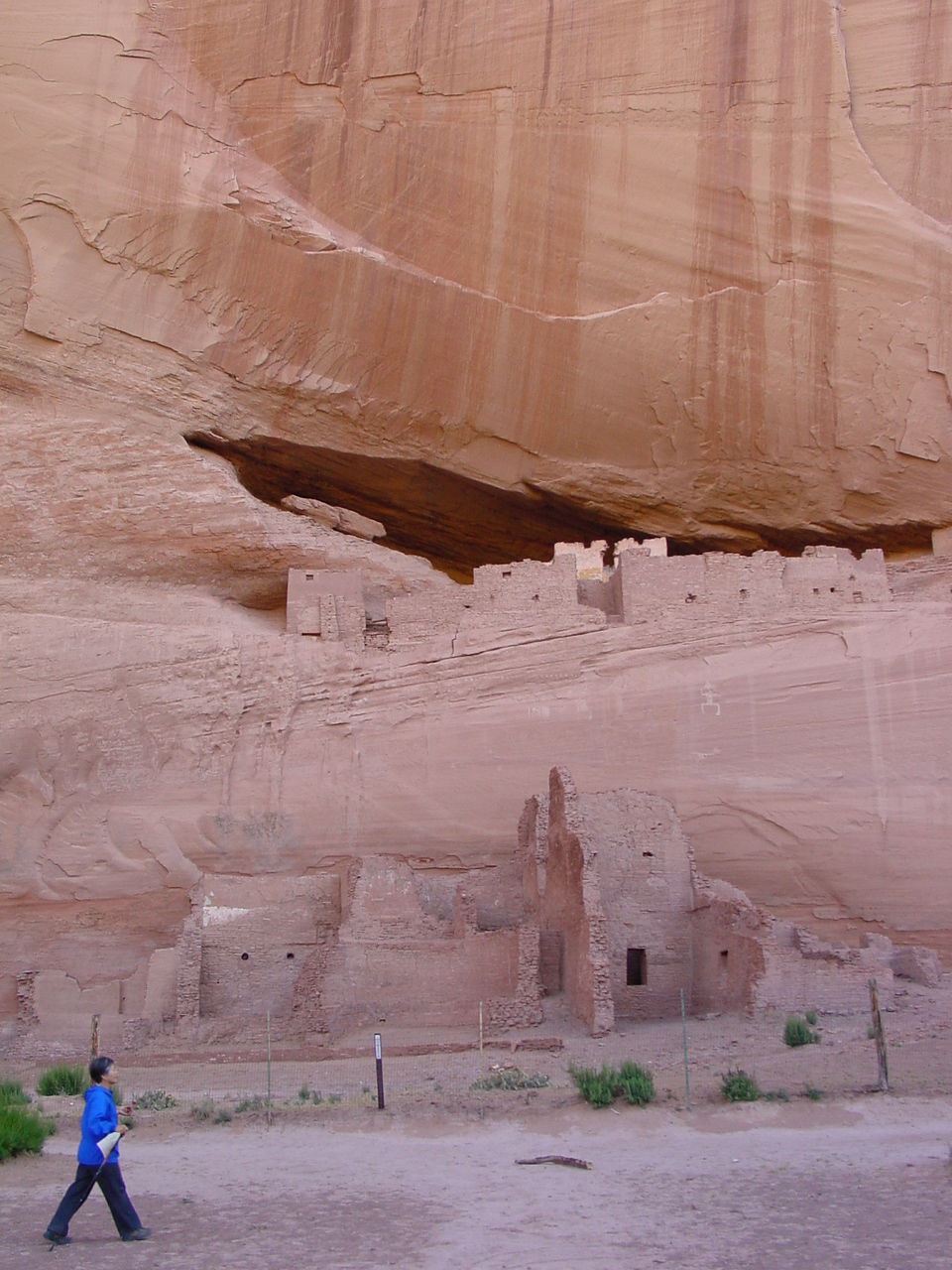
Like my visit to Carlsbad Caverns, being there early – I started down around 8:40 am – had the added advantage of having the hike down and the site mainly to myself. (I met even “earlier birds” already sweating their way up and only one person, a small, older Asian woman in a blue jacket, at the foot of the fenced-off ruins at ground level, behind which were the structures built into a horizontal gouge on the rosy-pink cliff-face some sixty or seventy feet above ground.) (The cliff face is slightly concave, curving upward for several hundred feet to the top of the canyon.).
Unlike the Cliff Palace or Balcony House at Mesa Verde National Park, where one can walk and climb (a little) around the cliff dwellings, the White House ruins, so named because the remains of the middle structure have a white-wash still visible, seem surreal because of the viewing distance and their coloring. It also feels lost and insignificant, dominated and framed by the canyon wall, which continues out of sight to the right and left.. I thought how like a grain of sand to an oyster this intrusion of mud-bricks and mortar must feel to the cliff, yet how, ultimately, each makes the whole greater than the parts alone: the oyster with a pearl, the canyon face with these physical remnants of laughter and life that it once enjoyed. The current silence contributed to that sensation of mystery and beauty, the only sounds being the soft swishing of the sand under my footsteps and the occasional bird-cry.
(I’ll have to continue in the next entry with my meeting of Henry Gray, the young Navajo, and his son as I was leaving the canyon floor for the hike up. And the eighteen hours in Las Vegas that felt like a year. Right now, it’s Tuesday morning in Los Angeles, and I’m heading to The Getty Center as soon as my laundry is dry. I’m behind in writing, but trying to catch up. I’ll have more time in Carmel on Thursday through Monday.)
No two days have been as different from each other as this past Saturday and Sunday. The former’s focus was the natural world of the Southwest: hiking at Canyon de Chelly near Chinle, AZ, the site of continuous inhabitation for 800+ years and home to spectacular Ancestral Puebloan ruins, and a drive around Sedona, AZ, known for its rock formations and energy “vortexes”. The latter, after a several hours drive, centered on man’s work: Hoover Dam and Las Vegas. (I use “man” because the dam was built in the 1930s, when the workforce was overwhelmingly male, and because I don’t think any woman would want to take credit for either conceiving and “delivering” Vegas.) Saturday was also a day of unexpected and significant conversations with potential long-term implications.
Chinle, the small town closest to Canyon de Chelly (pronounced “Shay”), is in the middle of Arizona’s Navajo Nation Reservation. I stayed at a Holiday Inn just two miles from the Visitor’s Center of this National Monument in order to hike in the morning, before the sun got too strong. While the nights have gone into the high-50s and the daytime temperatures remain comfortable in the shade, the mercury climbs into the 80s under the clear skies. (The wind helps keeping it cooler, sometimes a little too much: I drove through a dust storm of several miles approaching Chinle on Friday night, which left a thin layer of red clay/sand on Baby. Several sections of the highways between Cortez, CO and Chinle had warnings about dust storms. Given the sunny and windy climate of the region, I was surprised to see little wind or solar power usage. Don’t get me started about investments in renewable energy.)
One of the largest employers in Chinle is a Native youth correctional facility, whose motto is: “Restoring Youth To A Path of Harmony”. Henry Gray, the local Navajo I met later (more on that below), alluded to a non-trivial gang and drug problem brought back by tribe members exposed to those in the big cities. It’s one thing to read about that chapter of duplicity, venality, and, yes, racism, in our government’s dealings with Native Americans, it’s another to see the continuing consequences a hundred and fifty years later. It’s here, it’s now, and it’s appalling that it exists at the outer age of our consciousness. We talk – or at least the Republicans talk – about what a great nation we are, yet, as Martin Luther King said (I think it was him), no nation can be great when a segment of its people can’t/don’t share in the opportunities to achieve the collective dream. And it becomes particularly ironic and shaming when that segment is comprised of the REAL “Americans”.
If the Native American “problem” was in my mind at all while planning this portion of my trip, it was in the far periphery. This past week has been an unexpected and eye-opening experience. I know that I have always felt embarrassed seeing the Native American craftsmen selling their work off side-walk blankets set up under the shade of the old Governor’s Palace portico in Santa Fe Plaza. I think the embarrassment came from two sources, one of them shared: knowing that they weren’t showing/selling artifacts of their culture from a position of socio-economic and political strength and completeness, and, secondly, knowing that these were proud people with a strong cultural history and identity. There was a dual element of “doing them a favor” and “getting a bargain” (exacerbated by the haggling over prices) in the transactions that disrespected the culture and, thus, the people. Contrast, for example, our regard or French or Italian-products and how/where they are purchased. We wouldn’t dream of negotiating the price of an Armani suit, a Givenchy dress, or a Vuitton bag sold in their flagship stores. And we certainly don’t feel like we are doing them a favor, almost an act of charity by our purchase: in fact, quite the opposite. Subliminally, we know those are strong cultures and countries and we gain some of their cachet and “power” by having them, much like why cannibal cultures eat the flesh of strong enemies to get their strength. But we admire (and buy) Native American jewelry, for the most part, as much for the beauty as for the bargain. (I’m happy to argue this premise with anyone who is actually reading thig blog.)
(Sorry for the diatribe: back to the travelogue…)
While touring of the Canyon de Chelly is only allowed with Ranger-led groups or licensed guides, there is one trail, to the White House Ruins, which is self-guided. Due to time constraints, this is the one I had planned on doing. The trail begins at the overlook on the canyon rim, about a ten minute ride from the Park entrance, and ends at the ruins, a couple of hundred yards after reaching the bottom of the canyon. It’s a vertical descent of about 750 feet over the course of a mile to a mile and a quarter. (It doesn’t seem like much of a distance….if the ground was flat. Because of the hike UP, back to the mesa top, the estimated time is around 2 hours for a round trip.) The trail surface is uneven in places (and warned as slippery when wet) but wide and gives a great aerobic and lower-body work-out on the return trip.
Like my visit to Carlsbad Caverns, being there early – I started down around 8:40 am – had the added advantage of having the hike down and the site mainly to myself. (I met even “earlier birds” already sweating their way up and only one person, a small, older Asian woman in a blue jacket, at the foot of the fenced-off ruins at ground level, behind which were the structures built into a horizontal gouge on the rosy-pink cliff-face some sixty or seventy feet above ground.) (The cliff face is slightly concave, curving upward for several hundred feet to the top of the canyon.).
Unlike the Cliff Palace or Balcony House at Mesa Verde National Park, where one can walk and climb (a little) around the cliff dwellings, the White House ruins, so named because the remains of the middle structure have a white-wash still visible, seem surreal because of the viewing distance and their coloring. It also feels lost and insignificant, dominated and framed by the canyon wall, which continues out of sight to the right and left.. I thought how like a grain of sand to an oyster this intrusion of mud-bricks and mortar must feel to the cliff, yet how, ultimately, each makes the whole greater than the parts alone: the oyster with a pearl, the canyon face with these physical remnants of laughter and life that it once enjoyed. The current silence contributed to that sensation of mystery and beauty, the only sounds being the soft swishing of the sand under my footsteps and the occasional bird-cry.
(I’ll have to continue in the next entry with my meeting of Henry Gray, the young Navajo, and his son as I was leaving the canyon floor for the hike up. And the eighteen hours in Las Vegas that felt like a year. Right now, it’s Tuesday morning in Los Angeles, and I’m heading to The Getty Center as soon as my laundry is dry. I’m behind in writing, but trying to catch up. I’ll have more time in Carmel on Thursday through Monday.)
Days 11, 12 - Saturday and Sunday: Canyon de Chelly, Sedona, and Las Vegas.
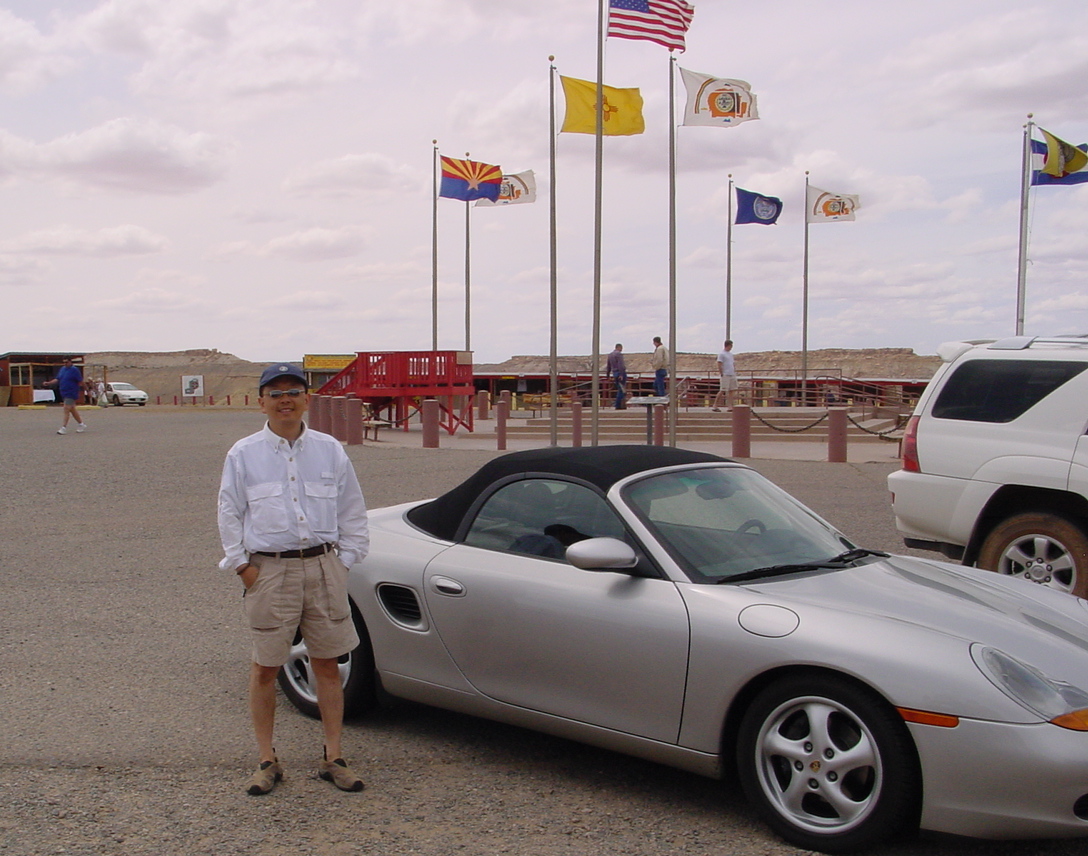
This is from a couple of days ago at Four Corners Monument, which is a spot where, like in Twister, one could have each hand and each foot on a different state: Colorado, Utah, Arizona, and New Mexico. Since it's an artificially created attraction, there is NOTHING there to see. The site, however, has something in common with The Great Wall of China: long sheds of souvenier stands selling T-shirts and knick-knacks.
I asked another visitor to take the photo and, while I shouldn't complain, the composition is terrible: "Baby" is, after all, my partner on this trip and her nose is cut-off! (Uh oh..... I'm referring to a car as a "partner". I need human company besides either Christian preachers on the radio or country-western songs!)
Saturday, May 22, 2004
Days 9, 10 - Thurday and Friday - Santa Fe and Mesa Verde, CO
A day that starts with an hour-long massage at Ten Thousand Waves, ends with a Rocky Mountain trout “…dusted with blue corn meal, pan-fried and served with a jocana slaw, fried squash blossoms and grilled horseradish sour cream…” AND has a Dairy Queen cone in between is a VERY good day. That was the case yesterday, Thursday.
Ten Thousand Waves is one of my two “must” stops during any visit to Santa Fe. The massage therapists are fantastic and worth the exposure to the (somewhat) New Age atmosphere. The spa itself is a series of multi-level earth-tone wooden rooms and platforms blending into and concealed by the indigenous landscape in the hills fifteen minutes northeast of Santa Fe. It’s billed as “Japanese-style” because of its communal (bathing-suit optional) hot tubs, architecture, and landscaping. (It certainly isn’t by the ethnicity of staff: there’s nary an Asian face in sight.) Some of the offerings are a bit exotic: aside from the nightingale-dropping facial (mentioned in a previous post), there are four-handed massages; massages with hot stones; in-water massages, to name the ones I remember.
Mine was just a simple deep-tissue massage with warm oils and focusing on the neck and shoulder areas, which are tight in the best of times, but now particularly so from all the accumulated miles of driving. “How was it?”, you ask. Well, it was the shortest hour of the trip. And the most heavenly. Jeanette (the therapist’s name) found the trouble-spots on both shoulders AND the release point for a recurring neck “crick”. I could have stayed on that table the entire day, but finished instead with a soak in the hot-tub, which, at that hour – 10:30 am – was empty. I skipped the cold-plunge this time. (On a previous visit, I rolled in the snow before climbing into one of the private tubs – there are several available. It was….different.)
My destination for Thursday’s drive was Mesa Verde National Park in the southwest corner of Colorado, with its spectacular and well-preserved ruins of Ancestral Puebloans (the new term vs. “Anasazi”) dwellings.
The road, mostly Route 550 North, goes through Cuba (!) and the town of Aztec (more about the “Aztec Ruins” later), and changes from flat to climbing and winding as it enters Colorado. And what has been a harsh, dry, inhospitable landscape of ground-hugging brown vegetation transforms, within a matter of miles, into hillsides of pine trees and irrigated fields. It took a little time to adjust to seeing so much green, particularly the green of grazing grass, after so much desolate scrub. Seeing snow-capped mountains (the Rockies?) in the distance, after the two days of crossing the flatlands of Texas and New Mexico, was also a reminder that I was making progress.
My main companion each day is NPR, when more powerful stations broadcasting country music, Christian rock (what a strange concept), or fundamentalist preachers do not drown it out. In the Southwest, many of the NPR stations have programs addressing the needs and interests of the Native American population. (If you look at a map of Arizona and New Mexico, there is a large patch-work of lands belonging to tribes whose names are familiar from movie Westerns: Apache, Hopi, Ute, Navajo, Zuni, Mescalero, etc. ) Thursday, for example, I listened to a call-in show with a dermatologist debunking the myth that dark(er) skin peoples are naturally protected from sunburns. The most interesting call was from a hunter in Alaska (!) asking about the sun-exposure from “…being out on the ice for hours at a time…”. You don’t get that on commercial radio!
(This is my first extended exposure to the state/status of Native Americans and it’s depressing and shaming. The top story on the Santa Fe NPR news was about Hopi tribe voting against having casinos, thus becoming the only tribe out of 23 in New Mexico to decline the opportunity. Considering the visible poverty in the Reservations I passed through, it’s admirable because, whilecasinos have not proven to be panaceas, they do inject cash and provide (some) employment. And yet, they are passing up on a projected $24 million/yr in revenue, according to the story. It also must be bitterly ironic to have one’s cultural artifacts be collectibles on eBay and worth thousands of dollars on “The Antiques Roadshow”, yet have both the highest unemployment AND lowest post-secondary education rates in the country. The history of injustices is lengthy and old news, as we all know, but the consequences are in the present and eye-opening when seen -- even briefly -- first-hand. It made me think about things that need doing.)
Thursday was also the day when I crossed the Continental Divide, at an elevation of 7380 ft., near Aztec, NM.. My dim recollection from 7th grade history/geography is that it has to do with….with…..I can’t remember. (If anyone knows and wants to add a comment to explain, please do!). Which brings me to the subject of Aztec Ruins National Monument, outside the town of Aztec.
Do NOT be fooled: there are NO Aztec (the culture) ruins at Aztec Ruins National Monument. What you find out there is that settlers in the 19th century THOUGHT the ruins (which are Native Puebloan) were Aztec because they couldn’t believe the “Indians” could build such structures. But the name stuck for the town and for the ruins, in what I think is a deliberate misnomer to attract tourist dollars, i.e. they are ruins and they are in Aztec (the town). The ruins themselves are interesting, but certainly not as much as they would be if they WERE from the Aztec civilization.
Despite my comments in the previous posting about The Far View Lodge at Mesa Verde National Park, I do recommend it because of its location inside the park. The nearest other lodging is 30+ minutes away, more if you are stuck being an RV on the spectacular-but-narrow-and-winding road between the Park entrance and the Visitor Center. By staying at The Far View , one can sleep a little later and still be there early enough to get tickets for the ranger-guided tours of the cliff dwellings. The rooms don’t have TVs or telephones, but do have outside balconies with chairs and that “far view”: there is nothing in sight for miles and miles. (A great place to sit, just after sunset, in the cool of the 7000 foot altitude, sip a single malt, and watch bright Venus above a sliver moon against a blue-black desert sky.)
The Metate Restaurant onsite, according to my waitress, was “..rated the 6th best in the entire state by Colorado Magazine”. Without having tried the five ahead of it, I would still rank it sixth. My trout was dry (I had the same dish tonight at the Holiday Inn in Chinle, AZ, and it was half the price and twice as moist), the rice pilaf lumpy, and the “strawberry and blueberry shortcake”, just a few strawberries (and even fewer blueberries) plus a dollop of whipped cream sandwiched between two cookies passing for short-bread. (If there is one thing I know, it’s short-bread: it’s one of the “S”s that make Scotland a frequent destination.) I ate, wrote post-cards, and tried to ignore the screaming child two tables away.
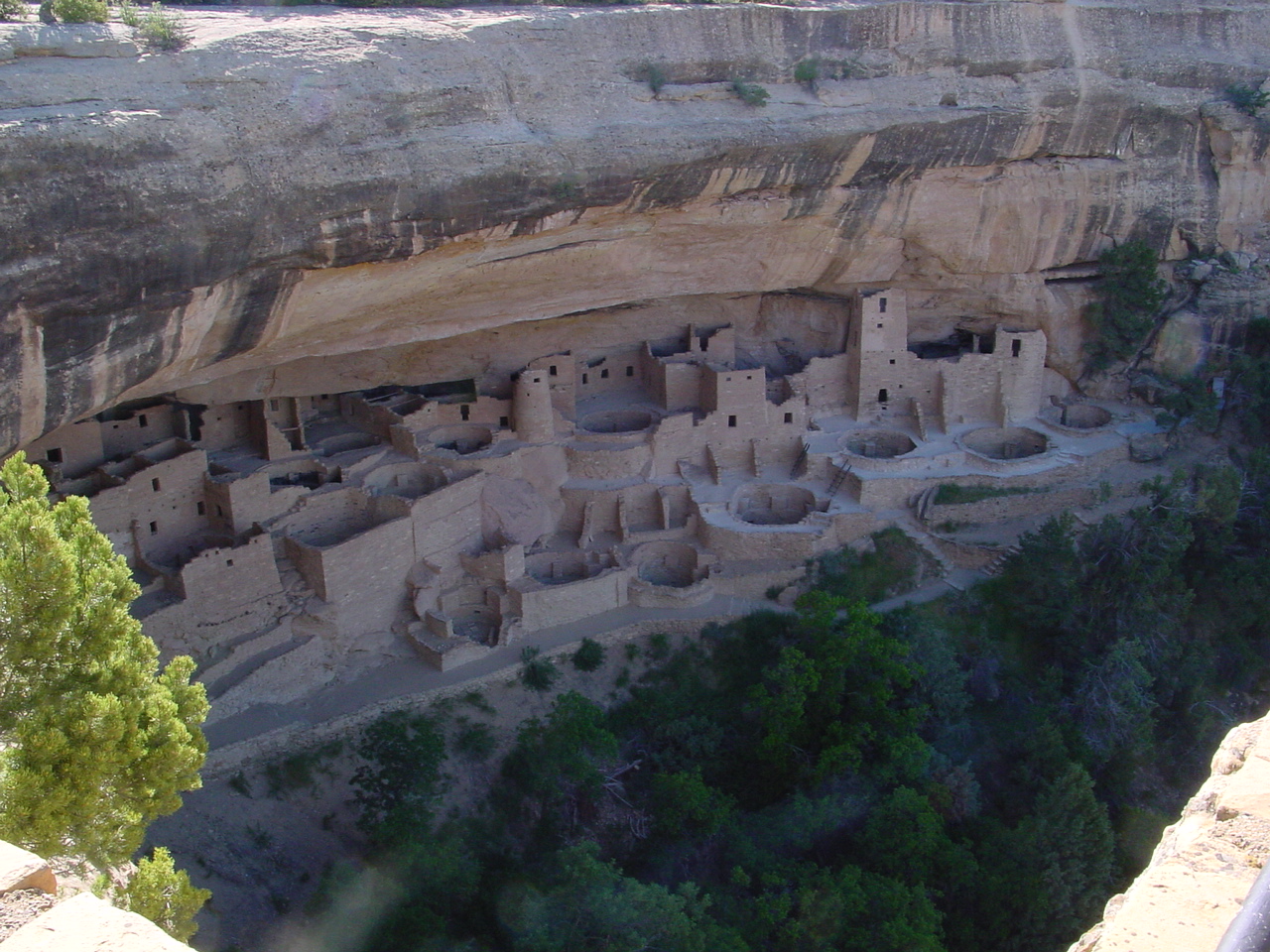
The two cliff-dwelling sites I toured this morning are easily recognizable for images, particularly Cliff Palace’s, that have become iconic. It looks the way ruins should look: structures intact enough to be recognizable for what they were originally, yet with enough jagged edges and incompleteness to show abandonment and create an aura of mystery. Photos make it look bigger than it really is. The sandstone-colored buildings stretch for less than the length of a football field and only a depth of less than a hundred feet – eighty nine feet, if I remember the Ranger’s recitation. All of it is recessed under the protective overhang of the scooped out base of the mesa, and the height of the natural opening, which I would estimate at a couple of hundred feet, gives it a dramatic frame and majesty.
Walking within the site and peering into the buildings is a humbling experience: the daily life of the Ancestral Puebloans was not easy. Forty would have been old age and infant mortality is estimated at 50%. Water was scarce, and in the case of Cliff Palace, the nearest source was miles away – speculation about their departure from the site centers on a 23 year-long drought in the late 1200s A.D. Access from the top of the mesa was via toe and hand-holds carved on the face of the cliff, not the series of ladders and wide steps we used (which still made my palms sweat). I left grateful for being born in our time.
Tomorrow, Saturday, it’s another on the list of “1000 Places To See Before You Die”: Canyon de Chelly National Monument, with the oldest Ancestral Puebloan ruins known, and then a three and half hour drive to Flagstaff followed by dinner in Sedona.
A day that starts with an hour-long massage at Ten Thousand Waves, ends with a Rocky Mountain trout “…dusted with blue corn meal, pan-fried and served with a jocana slaw, fried squash blossoms and grilled horseradish sour cream…” AND has a Dairy Queen cone in between is a VERY good day. That was the case yesterday, Thursday.
Ten Thousand Waves is one of my two “must” stops during any visit to Santa Fe. The massage therapists are fantastic and worth the exposure to the (somewhat) New Age atmosphere. The spa itself is a series of multi-level earth-tone wooden rooms and platforms blending into and concealed by the indigenous landscape in the hills fifteen minutes northeast of Santa Fe. It’s billed as “Japanese-style” because of its communal (bathing-suit optional) hot tubs, architecture, and landscaping. (It certainly isn’t by the ethnicity of staff: there’s nary an Asian face in sight.) Some of the offerings are a bit exotic: aside from the nightingale-dropping facial (mentioned in a previous post), there are four-handed massages; massages with hot stones; in-water massages, to name the ones I remember.
Mine was just a simple deep-tissue massage with warm oils and focusing on the neck and shoulder areas, which are tight in the best of times, but now particularly so from all the accumulated miles of driving. “How was it?”, you ask. Well, it was the shortest hour of the trip. And the most heavenly. Jeanette (the therapist’s name) found the trouble-spots on both shoulders AND the release point for a recurring neck “crick”. I could have stayed on that table the entire day, but finished instead with a soak in the hot-tub, which, at that hour – 10:30 am – was empty. I skipped the cold-plunge this time. (On a previous visit, I rolled in the snow before climbing into one of the private tubs – there are several available. It was….different.)
My destination for Thursday’s drive was Mesa Verde National Park in the southwest corner of Colorado, with its spectacular and well-preserved ruins of Ancestral Puebloans (the new term vs. “Anasazi”) dwellings.
The road, mostly Route 550 North, goes through Cuba (!) and the town of Aztec (more about the “Aztec Ruins” later), and changes from flat to climbing and winding as it enters Colorado. And what has been a harsh, dry, inhospitable landscape of ground-hugging brown vegetation transforms, within a matter of miles, into hillsides of pine trees and irrigated fields. It took a little time to adjust to seeing so much green, particularly the green of grazing grass, after so much desolate scrub. Seeing snow-capped mountains (the Rockies?) in the distance, after the two days of crossing the flatlands of Texas and New Mexico, was also a reminder that I was making progress.
My main companion each day is NPR, when more powerful stations broadcasting country music, Christian rock (what a strange concept), or fundamentalist preachers do not drown it out. In the Southwest, many of the NPR stations have programs addressing the needs and interests of the Native American population. (If you look at a map of Arizona and New Mexico, there is a large patch-work of lands belonging to tribes whose names are familiar from movie Westerns: Apache, Hopi, Ute, Navajo, Zuni, Mescalero, etc. ) Thursday, for example, I listened to a call-in show with a dermatologist debunking the myth that dark(er) skin peoples are naturally protected from sunburns. The most interesting call was from a hunter in Alaska (!) asking about the sun-exposure from “…being out on the ice for hours at a time…”. You don’t get that on commercial radio!
(This is my first extended exposure to the state/status of Native Americans and it’s depressing and shaming. The top story on the Santa Fe NPR news was about Hopi tribe voting against having casinos, thus becoming the only tribe out of 23 in New Mexico to decline the opportunity. Considering the visible poverty in the Reservations I passed through, it’s admirable because, whilecasinos have not proven to be panaceas, they do inject cash and provide (some) employment. And yet, they are passing up on a projected $24 million/yr in revenue, according to the story. It also must be bitterly ironic to have one’s cultural artifacts be collectibles on eBay and worth thousands of dollars on “The Antiques Roadshow”, yet have both the highest unemployment AND lowest post-secondary education rates in the country. The history of injustices is lengthy and old news, as we all know, but the consequences are in the present and eye-opening when seen -- even briefly -- first-hand. It made me think about things that need doing.)
Thursday was also the day when I crossed the Continental Divide, at an elevation of 7380 ft., near Aztec, NM.. My dim recollection from 7th grade history/geography is that it has to do with….with…..I can’t remember. (If anyone knows and wants to add a comment to explain, please do!). Which brings me to the subject of Aztec Ruins National Monument, outside the town of Aztec.
Do NOT be fooled: there are NO Aztec (the culture) ruins at Aztec Ruins National Monument. What you find out there is that settlers in the 19th century THOUGHT the ruins (which are Native Puebloan) were Aztec because they couldn’t believe the “Indians” could build such structures. But the name stuck for the town and for the ruins, in what I think is a deliberate misnomer to attract tourist dollars, i.e. they are ruins and they are in Aztec (the town). The ruins themselves are interesting, but certainly not as much as they would be if they WERE from the Aztec civilization.
Despite my comments in the previous posting about The Far View Lodge at Mesa Verde National Park, I do recommend it because of its location inside the park. The nearest other lodging is 30+ minutes away, more if you are stuck being an RV on the spectacular-but-narrow-and-winding road between the Park entrance and the Visitor Center. By staying at The Far View , one can sleep a little later and still be there early enough to get tickets for the ranger-guided tours of the cliff dwellings. The rooms don’t have TVs or telephones, but do have outside balconies with chairs and that “far view”: there is nothing in sight for miles and miles. (A great place to sit, just after sunset, in the cool of the 7000 foot altitude, sip a single malt, and watch bright Venus above a sliver moon against a blue-black desert sky.)
The Metate Restaurant onsite, according to my waitress, was “..rated the 6th best in the entire state by Colorado Magazine”. Without having tried the five ahead of it, I would still rank it sixth. My trout was dry (I had the same dish tonight at the Holiday Inn in Chinle, AZ, and it was half the price and twice as moist), the rice pilaf lumpy, and the “strawberry and blueberry shortcake”, just a few strawberries (and even fewer blueberries) plus a dollop of whipped cream sandwiched between two cookies passing for short-bread. (If there is one thing I know, it’s short-bread: it’s one of the “S”s that make Scotland a frequent destination.) I ate, wrote post-cards, and tried to ignore the screaming child two tables away.
The two cliff-dwelling sites I toured this morning are easily recognizable for images, particularly Cliff Palace’s, that have become iconic. It looks the way ruins should look: structures intact enough to be recognizable for what they were originally, yet with enough jagged edges and incompleteness to show abandonment and create an aura of mystery. Photos make it look bigger than it really is. The sandstone-colored buildings stretch for less than the length of a football field and only a depth of less than a hundred feet – eighty nine feet, if I remember the Ranger’s recitation. All of it is recessed under the protective overhang of the scooped out base of the mesa, and the height of the natural opening, which I would estimate at a couple of hundred feet, gives it a dramatic frame and majesty.
Walking within the site and peering into the buildings is a humbling experience: the daily life of the Ancestral Puebloans was not easy. Forty would have been old age and infant mortality is estimated at 50%. Water was scarce, and in the case of Cliff Palace, the nearest source was miles away – speculation about their departure from the site centers on a 23 year-long drought in the late 1200s A.D. Access from the top of the mesa was via toe and hand-holds carved on the face of the cliff, not the series of ladders and wide steps we used (which still made my palms sweat). I left grateful for being born in our time.
Tomorrow, Saturday, it’s another on the list of “1000 Places To See Before You Die”: Canyon de Chelly National Monument, with the oldest Ancestral Puebloan ruins known, and then a three and half hour drive to Flagstaff followed by dinner in Sedona.
Thursday, May 20, 2004
Day 8 - Santa Fe, NM to Mesa Verde National Park (Cortez, CO)
This will be VERY brief -- the real entry will be posted tomorrow -- since I've been given 15 minutes of airline from the basement office of the Far View Lodge where I am staying the night. (The rooms don't have telephones or TVs.) ARAMARK holds the concession for lodgings in this National Park, which was voted the TOP MONUMENT in teh 1999 reader's poll of Conde Nast's "Traveller Magazine, according to the plaque on one of the walls. It's all about location: the lodge looks like a run-down strip-mall Motel 6 at three times the price. More tomorrow!
This will be VERY brief -- the real entry will be posted tomorrow -- since I've been given 15 minutes of airline from the basement office of the Far View Lodge where I am staying the night. (The rooms don't have telephones or TVs.) ARAMARK holds the concession for lodgings in this National Park, which was voted the TOP MONUMENT in teh 1999 reader's poll of Conde Nast's "Traveller Magazine, according to the plaque on one of the walls. It's all about location: the lodge looks like a run-down strip-mall Motel 6 at three times the price. More tomorrow!
Day 8 - Albuquerque to Santa Fe, NM -
(Some blog "house-keeping": photos may not be forthcoming until I get a high-speed connection; I'll be posting links - upper right-hand under (duh!) "Links".)
While I've kept a personal journal off-and-on since receiving one for my eleventh birth-day, writing (somewhat) journalistic prose for an audience is a new and difficult experience. My "regular" writing is poetry, produced painstakingly (as some of you know) and not under deadline. Finding the right words in their right sequence to convey the imprecise precisely is as slow and laborious a process for me as it is for those Tibetan monks shown picking and placing individual grains of colored-sand, over a period of weeks, to create a Mandala comprised of complex patterns. (They sweep the completed work away as a symbol of the impermanence of things...amazing.) So please be kind if you see typos, dangling participles, etc.: believe me, they mortify me more than you ever could by calling attention to them.
The work on "Baby" was under $200.00, which left me positively light-headed. The technician also completed it in time for me to get to Santa Fe by noon on a beautiful, sunny, and moderately warm (mid-80s) day. I changed tonight's lodgings from a fellow Globalfreeloaders member (see link) to a condo unit in the Fort Marcy Condominium Resort Hotel within a ten minute (downhill) walk from the Plaza. (For those contemplating visiting Santa Fe, I highly recommend this place: my unit is large, has a fireplace, separate bed-room, and a kitchen. And, it was $49.95!! Use "hotels.com" to get a good rate, then call Fort Marcy's reservations desk. They'll match the "hotels.com" price, but save you from paying the "hotels.com" booking fee.)
I spent the afternoon wandering around familiar places -- I've been to Santa Fe several times before -- including a gallery exhibiting photographs by Margaret Bourke-White, and finished the evening with dinner at the Coyote Cafe, which is a favorite from past trips.
Tomorrow morning, the reason for stopping here: a massage at Ten Thousand Waves, a Japanese-style spa in the hills outside of town (see link). It's worth trip. (They have a facial that uses nightingale dung....It's sterilized, of course, but still! I thought about it earlier when I saw a local character walking around with a parrot on his left shoulder...and white splotches of parrot poop on the back of his black shirt...)
Lastly, from Katherine Hepburn's biography (one of my audio books), her take on life: "...work hard, love someone, and have some fun. And if you are lucky, be loved back and have good health." Can't argue with that. She and the Dalai Lama would have made a great couple.
(Some blog "house-keeping": photos may not be forthcoming until I get a high-speed connection; I'll be posting links - upper right-hand under (duh!) "Links".)
While I've kept a personal journal off-and-on since receiving one for my eleventh birth-day, writing (somewhat) journalistic prose for an audience is a new and difficult experience. My "regular" writing is poetry, produced painstakingly (as some of you know) and not under deadline. Finding the right words in their right sequence to convey the imprecise precisely is as slow and laborious a process for me as it is for those Tibetan monks shown picking and placing individual grains of colored-sand, over a period of weeks, to create a Mandala comprised of complex patterns. (They sweep the completed work away as a symbol of the impermanence of things...amazing.) So please be kind if you see typos, dangling participles, etc.: believe me, they mortify me more than you ever could by calling attention to them.
The work on "Baby" was under $200.00, which left me positively light-headed. The technician also completed it in time for me to get to Santa Fe by noon on a beautiful, sunny, and moderately warm (mid-80s) day. I changed tonight's lodgings from a fellow Globalfreeloaders member (see link) to a condo unit in the Fort Marcy Condominium Resort Hotel within a ten minute (downhill) walk from the Plaza. (For those contemplating visiting Santa Fe, I highly recommend this place: my unit is large, has a fireplace, separate bed-room, and a kitchen. And, it was $49.95!! Use "hotels.com" to get a good rate, then call Fort Marcy's reservations desk. They'll match the "hotels.com" price, but save you from paying the "hotels.com" booking fee.)
I spent the afternoon wandering around familiar places -- I've been to Santa Fe several times before -- including a gallery exhibiting photographs by Margaret Bourke-White, and finished the evening with dinner at the Coyote Cafe, which is a favorite from past trips.
Tomorrow morning, the reason for stopping here: a massage at Ten Thousand Waves, a Japanese-style spa in the hills outside of town (see link). It's worth trip. (They have a facial that uses nightingale dung....It's sterilized, of course, but still! I thought about it earlier when I saw a local character walking around with a parrot on his left shoulder...and white splotches of parrot poop on the back of his black shirt...)
Lastly, from Katherine Hepburn's biography (one of my audio books), her take on life: "...work hard, love someone, and have some fun. And if you are lucky, be loved back and have good health." Can't argue with that. She and the Dalai Lama would have made a great couple.
Wednesday, May 19, 2004
Days 6, 7 – Carlsbad (Caverns), Roswell (UFOs!), Artesia (home-made “gorditas” and tamales), and Albuquerque (car repair), NM.
Yesterday (Monday) was a better than a good day. Any day when I can “DQ” (Dairy Queen) not just once, but twice (!) gets a gold star. There is better ice-cream and gourmet flavors aplenty elsewhere, but nothing beats a simple cone of soft vanilla, with the signature swirl on top, to take me back forty years to when my first house in America was two blocks from the local franchise. A cone was a dime then….
The first one yesterday was at a DQ just off I-20 at the exit for Baird,Tx after two hours of visual monotony: mile after mile of a pencil-straight road bordered by table-top-flat farm land. Aside from the slight side-motion of the car, buffetted by an unrelenting cross-wind, the only other distraction was the steady impact of insects on the wind-shield. (After a while, I amused myself by trying to predict the next spot and what the “connect-the-splats” would produce in outline. It looked something close to Lincoln’s profile at one point.)
The DQs here have a full fast-food menu and this one was no exception. The chicken fingers were tender, freshly made, the portion-size generous, and my order brought to the table. It also came with a slice of toast (??) in addition to the fries. And, along the lines of “you know you’re in Texas when…”, my small drink was a 24 oz. (!!) cup. (You also know you’re in Texas when the predominant road-kill is armadillos and turtles.)
I arrived in Carlsbad in the late afternoon, my destination an Econolodge on the south side of town. It had been my intention to spend two nights, exploring Carlsbad Caverns National Park today (Tue.), including the tours requiring head-lamps and knee pads. However, replacing the burned out headlight bulb was a priority and the nearest Porsche dealership along my route was in Albuquerque, with their service department requiring the car for a few hours. (I decided to also get an early oil change as long as it was at a dealer.) Thankfully, re-shuffling things on the way from Carlsbad to Roswell and Albuquerque, was fairly easy to do and still allowed for a morning at the Caverns.
The Caverns. By getting there as the park opened at 8:30 am, I was among the first dozen to take the self-guided “Natural Entrance” tour, which is a 750 ft descent over a mile and a half into the bowels of the main cave. (And, by being the youngest – by far – or, at least, the fastest walker among that first group, I was alone for most of the time, which enhanced the experience. The lighting is subdued, so one can pretend to be an early explorer, though they didn’t have the benefit of broad and smooth paths with hand-rails. As for the sights, I would say that, if you’ve seen one staglamite, you’ve seen them all…if I were only a cynic. Yes, they start looking the same after a while, and, no, I couldn’t always match the formations with the imaginative names (“Chinese Temple”, “Bottomless Pit” – which the small-print acknowledged was actually 140 ft. deep…), but the scale of the place is astonishing and deserving of superlatives…which would also apply to the gift-shop and the other concessions designed to separate the visitor and his money.
The “Natural Entrance” tour segues into the “Big Room” tour, which is another mile-long loop, this time around the main chamber at the bottom of the visitor-accessible area. I took it as well, but for this portion, there were more people along the way, though I was still the youngest in most cases and, still, the fastest. (It reinforced the decision to make this trip now vs. later. First, “Golden Years” aren’t guaranteed. Secondly, given how much huffing and puffing I heard, I am glad to be travelling while still vigorous and (relatively) youthful.)
My next stop, in Artesia, NM, a small town 45 minutes north of Carlsbad – the caverns are 30 minutes south of Carlsbad proper – was the highlight of the day. Elizabeth, my young ex-colleague and friend, grew up in Artesia, to which her parents had immigrated from Mexico some thirty years ago, and where he still farms land leased from the same owner. (I “found” Elizabeth and her husband Paul, hired both into the firm, and trained, managed, and mentored her during her tenure at TP.) I had to pass through Artesia to Roswell, so she invited me meet her parents, since they had heard about me already over the years and that I spoke Spanish. (The original invitation had to been to have breakfast with them on Wednesday, but this changed to lunch, Tuesday, because of my car problems.) And that’s how I came to have fresh, home-made tamales and “gorditas” (deep-fried corn-dough pockets filled with beans and/or carne -- yum!) for lunch today and meet both her parents, Pilar and Enrique, and her brother Henry, in the photo below:
Elizabeth's parents and her brother

Most of the conversation was in Spanish, since it was a more comfortable language for the parents, but I did manage to convey how much I enjoyed working with Elizabeth and how proud they could feel about her combination of strong values, intelligence and industry. I told them how, seeing the children, we also see the parents and it was clear how Elizabeth reflected them.
Roswell was next or, rather, the “UFO Museum and International Research Center” in Roswell. It was in the outskirts of Roswell that the crash of a purported UFO, complete with little gray/green men, occurred in 1947 and was subsequently allegedly covered up by the government. The museum is in the space of a former movie theater and consists of a large, open space with displays, mostly text and photos, along the walls. The production value of the displays is on a par with that seen in middle-school science fairs – large matte-boards with lots of writing, big-headlines, diagrams and pasted-on illustrations or photos. By the very nature of the subject, there are no artifacts of proven extra-terrestrial manufacture or provenance. The best exhibit is a prop from a movie about the cover-up: a dummy alien on an operating table, complete with a gowned and masked mannequim doctor ready to dissect… The shop is worth a visit because of all the gee-gaws and T-shirts (some very imaginative) with the alien/UFO theme. See for yourself:
A store across from the UFO Museum. (Click on the photo to read some of the small print on the windows.)

I parked here for the museum. A little green man wearing a "E-Z Parking" T-shirt took my money...

The focal point of the alien experience in Roswell. (I love the "Research Center" subtitle.)
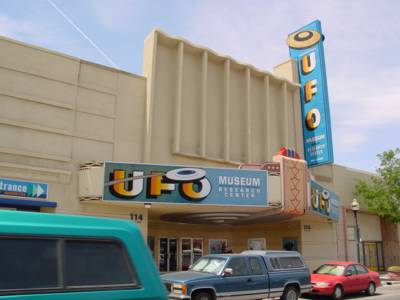
I wonder how Einstein would have felt about having his portrait in the museum.

Draw your own conclusions: REAL alien or something from a bad art class?

"Alien" in suspended animation...

A close-up. How seriously can one take a "museum" that uses movie props?

The "best" exhibit in the whole place. A prop donated by the makers of a schlock film about the Roswell Incident.

The "doctor" seems poised to fight or flee, but not to perform an autopsy...

So, what did I learn today? From the Caverns, that Time is insignificant to a ceiling drip that will take tens of thousands of years to form a staglamite, and how to use that in meditation. From lunch at the Hernandez’, a reminder about how hard first-generation immigrants work for the second-generation and how much our society would lose without both. From the Dalai Lama (on CD) that it’s not the fame of the teacher, the elegance of the writing, the themes of the lessons, or the truths in the teaching that matter, but our emotional connection/response to what is heard. (So why do gurus have followers??) And from the drive itself, that the way to average over 90 mph for fifty miles is to have a straight road, sparse traffic, and a bigger idiot averaging 95 mph ahead of you.
Tomorrow, it’s Santa Fe in the afternoon, after the car is done. At least it shouldn’t be a another case of “Oh, about a thousand dollars”….(see first entry).
Yesterday (Monday) was a better than a good day. Any day when I can “DQ” (Dairy Queen) not just once, but twice (!) gets a gold star. There is better ice-cream and gourmet flavors aplenty elsewhere, but nothing beats a simple cone of soft vanilla, with the signature swirl on top, to take me back forty years to when my first house in America was two blocks from the local franchise. A cone was a dime then….
The first one yesterday was at a DQ just off I-20 at the exit for Baird,Tx after two hours of visual monotony: mile after mile of a pencil-straight road bordered by table-top-flat farm land. Aside from the slight side-motion of the car, buffetted by an unrelenting cross-wind, the only other distraction was the steady impact of insects on the wind-shield. (After a while, I amused myself by trying to predict the next spot and what the “connect-the-splats” would produce in outline. It looked something close to Lincoln’s profile at one point.)
The DQs here have a full fast-food menu and this one was no exception. The chicken fingers were tender, freshly made, the portion-size generous, and my order brought to the table. It also came with a slice of toast (??) in addition to the fries. And, along the lines of “you know you’re in Texas when…”, my small drink was a 24 oz. (!!) cup. (You also know you’re in Texas when the predominant road-kill is armadillos and turtles.)
I arrived in Carlsbad in the late afternoon, my destination an Econolodge on the south side of town. It had been my intention to spend two nights, exploring Carlsbad Caverns National Park today (Tue.), including the tours requiring head-lamps and knee pads. However, replacing the burned out headlight bulb was a priority and the nearest Porsche dealership along my route was in Albuquerque, with their service department requiring the car for a few hours. (I decided to also get an early oil change as long as it was at a dealer.) Thankfully, re-shuffling things on the way from Carlsbad to Roswell and Albuquerque, was fairly easy to do and still allowed for a morning at the Caverns.
The Caverns. By getting there as the park opened at 8:30 am, I was among the first dozen to take the self-guided “Natural Entrance” tour, which is a 750 ft descent over a mile and a half into the bowels of the main cave. (And, by being the youngest – by far – or, at least, the fastest walker among that first group, I was alone for most of the time, which enhanced the experience. The lighting is subdued, so one can pretend to be an early explorer, though they didn’t have the benefit of broad and smooth paths with hand-rails. As for the sights, I would say that, if you’ve seen one staglamite, you’ve seen them all…if I were only a cynic. Yes, they start looking the same after a while, and, no, I couldn’t always match the formations with the imaginative names (“Chinese Temple”, “Bottomless Pit” – which the small-print acknowledged was actually 140 ft. deep…), but the scale of the place is astonishing and deserving of superlatives…which would also apply to the gift-shop and the other concessions designed to separate the visitor and his money.
The “Natural Entrance” tour segues into the “Big Room” tour, which is another mile-long loop, this time around the main chamber at the bottom of the visitor-accessible area. I took it as well, but for this portion, there were more people along the way, though I was still the youngest in most cases and, still, the fastest. (It reinforced the decision to make this trip now vs. later. First, “Golden Years” aren’t guaranteed. Secondly, given how much huffing and puffing I heard, I am glad to be travelling while still vigorous and (relatively) youthful.)
My next stop, in Artesia, NM, a small town 45 minutes north of Carlsbad – the caverns are 30 minutes south of Carlsbad proper – was the highlight of the day. Elizabeth, my young ex-colleague and friend, grew up in Artesia, to which her parents had immigrated from Mexico some thirty years ago, and where he still farms land leased from the same owner. (I “found” Elizabeth and her husband Paul, hired both into the firm, and trained, managed, and mentored her during her tenure at TP.) I had to pass through Artesia to Roswell, so she invited me meet her parents, since they had heard about me already over the years and that I spoke Spanish. (The original invitation had to been to have breakfast with them on Wednesday, but this changed to lunch, Tuesday, because of my car problems.) And that’s how I came to have fresh, home-made tamales and “gorditas” (deep-fried corn-dough pockets filled with beans and/or carne -- yum!) for lunch today and meet both her parents, Pilar and Enrique, and her brother Henry, in the photo below:
Elizabeth's parents and her brother

Most of the conversation was in Spanish, since it was a more comfortable language for the parents, but I did manage to convey how much I enjoyed working with Elizabeth and how proud they could feel about her combination of strong values, intelligence and industry. I told them how, seeing the children, we also see the parents and it was clear how Elizabeth reflected them.
Roswell was next or, rather, the “UFO Museum and International Research Center” in Roswell. It was in the outskirts of Roswell that the crash of a purported UFO, complete with little gray/green men, occurred in 1947 and was subsequently allegedly covered up by the government. The museum is in the space of a former movie theater and consists of a large, open space with displays, mostly text and photos, along the walls. The production value of the displays is on a par with that seen in middle-school science fairs – large matte-boards with lots of writing, big-headlines, diagrams and pasted-on illustrations or photos. By the very nature of the subject, there are no artifacts of proven extra-terrestrial manufacture or provenance. The best exhibit is a prop from a movie about the cover-up: a dummy alien on an operating table, complete with a gowned and masked mannequim doctor ready to dissect… The shop is worth a visit because of all the gee-gaws and T-shirts (some very imaginative) with the alien/UFO theme. See for yourself:
A store across from the UFO Museum. (Click on the photo to read some of the small print on the windows.)

I parked here for the museum. A little green man wearing a "E-Z Parking" T-shirt took my money...

The focal point of the alien experience in Roswell. (I love the "Research Center" subtitle.)

I wonder how Einstein would have felt about having his portrait in the museum.

Draw your own conclusions: REAL alien or something from a bad art class?

"Alien" in suspended animation...

A close-up. How seriously can one take a "museum" that uses movie props?

The "best" exhibit in the whole place. A prop donated by the makers of a schlock film about the Roswell Incident.
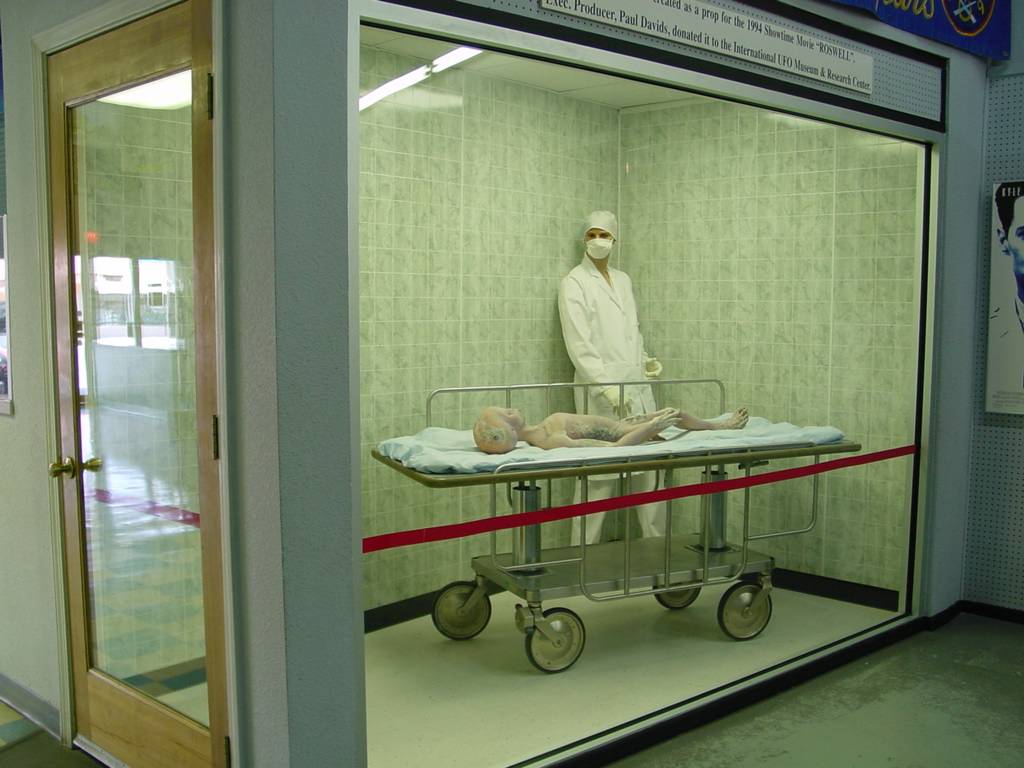
The "doctor" seems poised to fight or flee, but not to perform an autopsy...

So, what did I learn today? From the Caverns, that Time is insignificant to a ceiling drip that will take tens of thousands of years to form a staglamite, and how to use that in meditation. From lunch at the Hernandez’, a reminder about how hard first-generation immigrants work for the second-generation and how much our society would lose without both. From the Dalai Lama (on CD) that it’s not the fame of the teacher, the elegance of the writing, the themes of the lessons, or the truths in the teaching that matter, but our emotional connection/response to what is heard. (So why do gurus have followers??) And from the drive itself, that the way to average over 90 mph for fifty miles is to have a straight road, sparse traffic, and a bigger idiot averaging 95 mph ahead of you.
Tomorrow, it’s Santa Fe in the afternoon, after the car is done. At least it shouldn’t be a another case of “Oh, about a thousand dollars”….(see first entry).
Subscribe to:
Posts (Atom)